Proof of concept links business-governed warehouse transport tasks to autonomous robots and returns execution status to management software.
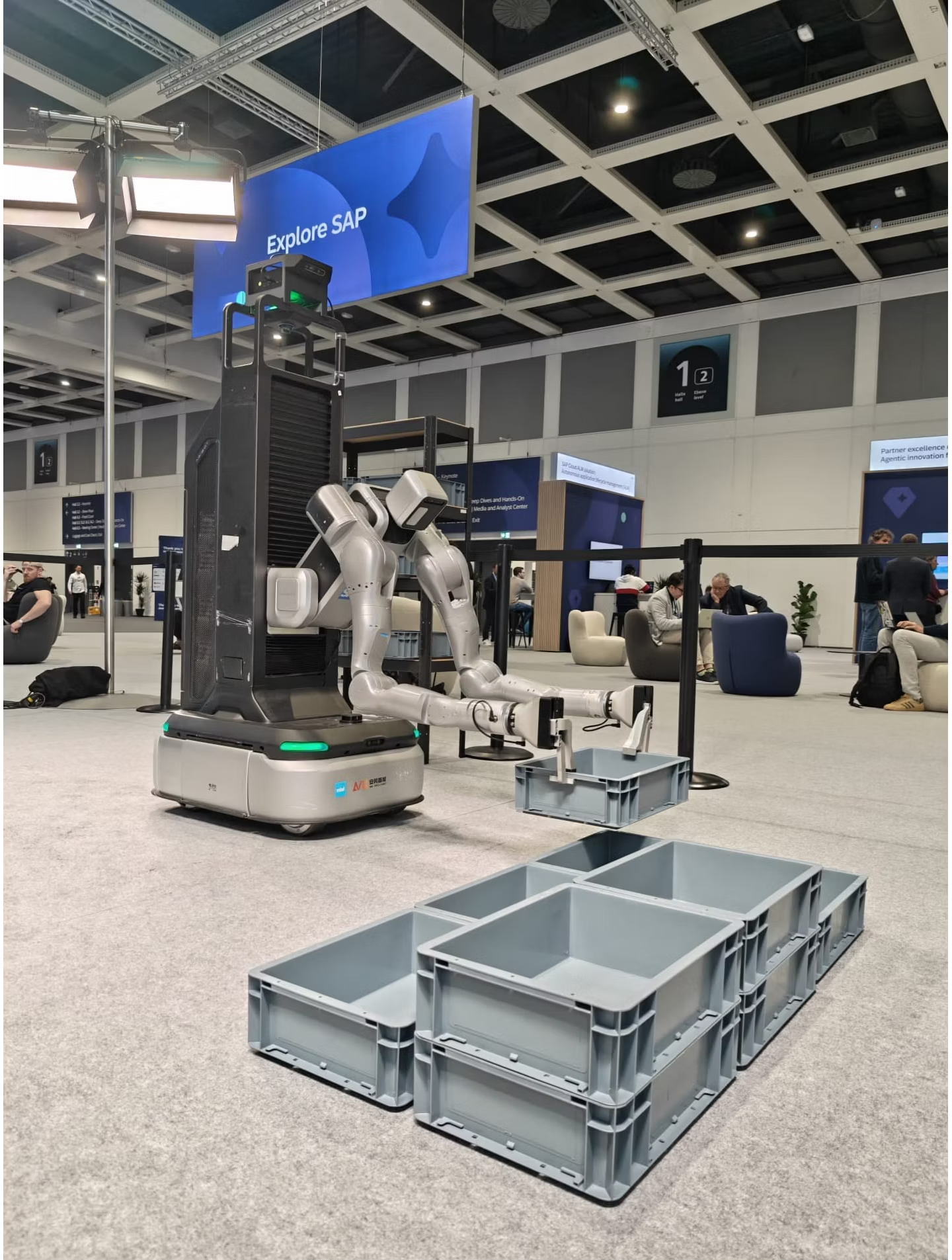
Intel and SAP have demonstrated a proof of concept that connects SAP Extended Warehouse Management (EWM) with autonomous robots using Intel’s edge AI and robotics technology. Conducted at Intel’s Chengdu site in China, the demonstration turns warehouse transport requests into robot missions and returns task-status and completion information to SAP EWM.
“Organizations want to connect AI directly to physical operations. By combining SAP’s enterprise context and orchestration with Intel’s edge AI and robotics technologies, we can help customers move Physical AI from business decision to real-world execution.” said John Healy, Vice President and General Manager, Industrial and Robotics at Intel.
SAP supplies the business context, workflow governance and process rules; Intel provides the edge computing and robotics hardware and software for autonomous material transport. According to Intel’s announcement, status, outcomes and exceptions flow back into enterprise systems.
In the demonstration, SAP EWM initiates transport requests that are dispatched to autonomous robots. The robots move materials and report task status and completion back to the warehouse-management system.
For the Intel demonstration, the companies specifically describe autonomous material transport and feedback into SAP EWM. SAP also identifies Anu Intelligence as a Physical AI ecosystem partner involved in the project.
The companies say the proof of concept reduced transport distances and repetitive manual handling.
Open architecture
Intel describes the architecture as open and robot-agnostic, intended to preserve customer choice across robot vendors, operating systems, AI models and cloud or on-premises deployments. The aim is to develop the proof of concept into a repeatable approach for deployment across sites and robot platforms.
Intel’s broader robotics portfolio includes OpenVINO Physical AI, Physical AI Studio and Robotics AI Suite. Its public Robotics AI Suite repository provides applications, libraries, examples and benchmarking tools for autonomous mobile robots, stationary arms and humanoid systems, with ROS 2 integration and OpenVINO-optimized AI models.
SAP’s separate warehouse Physical AI reference architecture describes a wider set of operations, including picking, placing, sorting and packing.
“Physical AI can reshape operations by connecting enterprise systems with operational technology. SAP and Intel are creating solutions to help customers integrate AI-driven automation into core processes while preserving flexibility across robotics platforms, deployment models and ecosystem partners across both hardware and software.” said Lukasz Ostrowski, Head of Physical AI and Robotics, SAP Research and Innovation for SAP SE.
What manufacturers can take from the demonstration
The practical significance is the connection between warehouse-management decisions and autonomous execution, with task outcomes reported back into the system governing the work.
The announcements do not specify the interfaces or messaging protocols used in the proof of concept, identify its AI models, or explain how failed tasks are recovered or escalated. Intel says exceptions return to enterprise systems, but does not detail the recovery process.
For manufacturers, the next questions are how much integration work another deployment would require, which components can be reused and whether the reported improvements hold up under production conditions.