The system learns as it welds to address the variables that have made these types of welding difficult to automate.
ESAB has introduced a collaborative robot system that uses artificial intelligence (AI) and camera and laser sensing to adjust welding motion and process parameters in response to changing conditions.
The ROBBI AI system is designed for metal fabrication applications involving variable joint fit-up, low-volume, high-mix production and welding tasks that can be difficult to automate, including pipe fabrication and tungsten inert gas (TIG) welding, ESAB said in an Oct. 22 announcement.
Unlike conventional robotic welding systems that rely on predefined paths and weld sequences, ROBBI AI generates its own weld path and makes decisions as welding progresses. Operators provide welding procedure parameters, including consumables, material type and weld type, before initiating the process.
“Physical AI brings intelligence directly into the welding process,” said Dan Colvin, vice president of Advanced Technology Solutions at ESAB. “Instead of programming every movement and anticipating every possible variation, ROBBI AI assesses the joint, determines how to proceed and can make adjustments while welding. It is also designed to learn from every weld, helping it recognize conditions that can lead to defects and respond by adjusting welding parameters or stopping the weld when needed.”
Adapting to changing conditions
The system uses its sensing capabilities to evaluate the workpiece, identify the expected joint and determine how to proceed within the parameters established for the application.
“As welding progresses, ROBBI AI can adapt its motion and welding parameters to changing conditions,” Colvin said. “For example, if a joint gap opens or closes, the system can adjust its travel motion, oscillation or welding parameters as appropriate within the established procedure. Rather than relying solely on a predetermined weld sequence, it can make welding decisions in real time.”
The system also supports conventional cobot operation, allowing users to disable full-AI mode and operate the robot using more traditional methods.
Learning from weld data
ROBBI AI undergoes a simulation-based learning period before deployment. Once installed at a customer’s facility, it continues to collect weld data and associated video, which operators can review to investigate defects and identify opportunities for improvement.
If the system detects a condition that could compromise a weld, it can stop welding. Operators can then review the recorded information and provide feedback to help the AI recognize similar conditions in the future, ESAB said.
AI processing takes place locally on a computer within the customer’s facility rather than relying on continuous communication with a cloud-based system. According to ESAB, this keeps the system’s learning data onsite and supports real-time decision-making.
The company also uses its InduSuite software to help keep AI-driven welding decisions within established welding procedure specifications and qualification requirements.
“We use our existing InduSuite software to help keep AI-driven welding decisions within predefined welding procedure specifications and qualification requirements,” Colvin said. “ESAB’s approach is designed to reduce the risk of AI-driven adjustments that could result in welding outside those specifications or with an unapproved procedure.”
Robot and power-source options
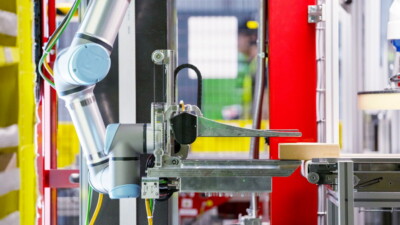
The ESAB cobot system uses either a Universal Robots UR10e or UR20e robot arm. It is available with a seventh-axis configuration to extend its reach and accommodate a larger work envelope, or on a wheeled cart that allows it to be moved around a shop.
Compatible welding power sources include the EWM Titan XQ, EWM Tetrix XQ and ESAB Aristo Edge 500R.
ESAB identifies TIG welding and pipe fabrication for data centers and other infrastructure projects as potential applications for ROBBI AI, particularly where specialized welding skills are required and conventional automation can be challenging to implement.
TIG welding can be difficult to automate because the process requires precise control of the torch, filler wire and molten weld pool. In a study published in the International Journal of Pressure Vessels and Piping, researchers examining robotic orbital TIG welding of 304L stainless-steel pipes found that maintaining a stable weld pool during the root pass was particularly challenging as the torch moved around the pipe and the welding position changed.
A manual welder can continually adjust the torch trajectory and filler-metal feed to control the pool; reproducing that control through automation requires carefully developed welding parameters. The researchers also found that the process remained sensitive to geometric variations in pipe joints.
“With ROBBI AI, we are extending the role of AI beyond digital analysis and into the physical welding process, where intelligent decisions can directly influence how a weld is made,” Colvin said.