Physics AI is a new technology that promises to transform science and engineering. It’s not the same as physical AI.
This article was written and contributed to Engineering.com by Pete Schlampp, CEO of Luminary. All opinions are his own.
In 2024, Demis Hassabis and John Jumper of Google DeepMind shared the Nobel Prize in Chemistry for AlphaFold, a model that solved a 50-year-old grand challenge in biology, known as the protein folding problem, by turning genetic sequences into accurate 3D structural models. Remarkably, the DeepMind team was able to use the model to predict the structures of virtually all 200 million proteins known to science.
A year earlier, DeepMind’s GraphCast produced 10-day weather forecasts more accurate than the leading operational forecasting system, on roughly 90 percent of the measures tested and with each forecast generated in under a minute instead of hours on a supercomputer. In February 2025, the European Centre for Medium-Range Weather Forecasts began running a machine-learning model operationally alongside its existing system, reporting gains of up to 20 percent on tropical cyclone predictions and a thousandfold reduction in the energy required to produce a forecast.
Both of these systems share a common trait: they predict how a physical system will behave before anyone runs an experiment. That same capability is now being leveraged by organizations which design, manufacture, and operate physical products.
The difference between physical AI and physics AI
Two labels get used interchangeably for this work: physical AI and physics AI. Yet they describe different things. Physical AI operates machines that act in the world. Physics AI predicts how the world will behave.
Physical AI is the better-known term. Physical AI gives robots and autonomous machines the ability to perceive an environment, reason about it, and act in it. The models enable robots to learn navigational skills: grasping an object, walking across uneven ground, handling something they’ve never seen before. Trained on trillions of tokens from images, video, and sensor data, they’re equipped for the many edge cases that a robotic system might encounter as it accomplishes useful tasks in a variety of environments.
The challenge is clear, and tremendously challenging to overcome: a robot has to make safe decisions in the open world, in real time, based on rich, unstructured information about its surroundings. If solved, it promises to transform much of the physical economy by providing dramatically greater access to physical labor and automation.
Physics AI, while built on similar underlying technology, answers a fundamentally different question: how will a physical system behave? Will a new aircraft wing generate enough lift to take off? How fast can an EV battery charge before it overheats? Will a car’s frame protect the people riding inside during a crash?
For most of the last century, engineers have answered these questions with simulation software that models reality by solving the equations of physics, point by point, across a virtual version of the object. It works. The answers are trustworthy. But it’s slow: a single simulation can take hours or days on a roomful of computers. Setting up the model beforehand can take days of time.
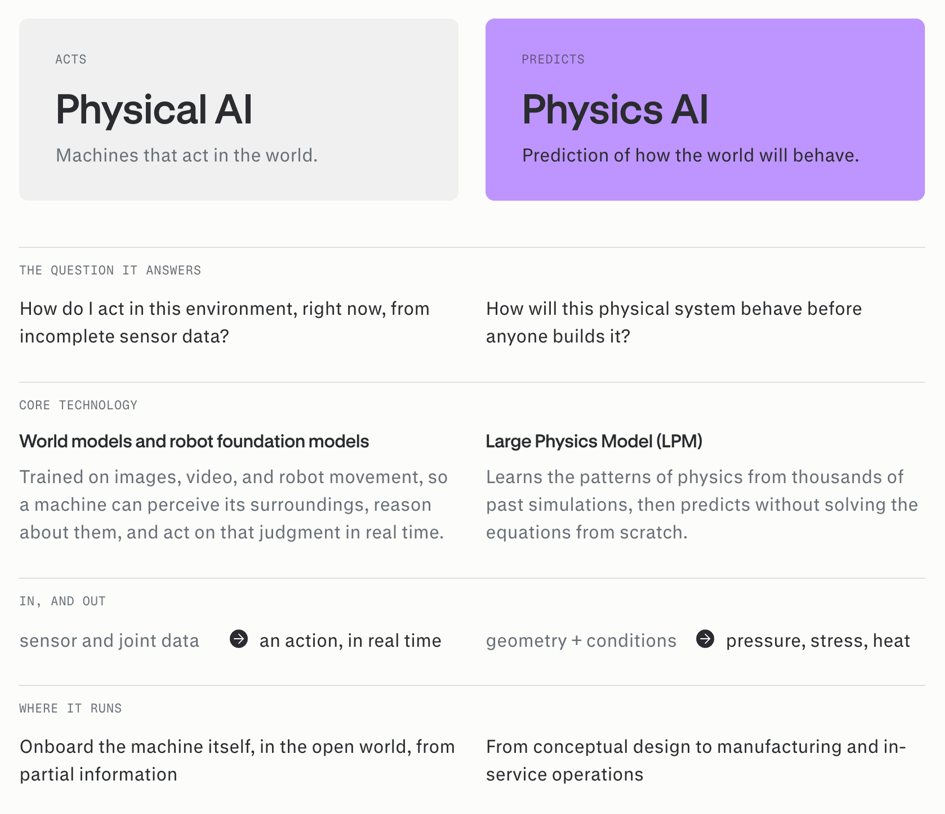
Physics AI promises to provide the same virtual model, but predicted directly with AI. Its core technology is the Large Physics Model, or LPM. The parallel with large language models is intentional: an LLM learns the patterns of language from billions of documents and then writes new text without looking anything up. An LPM learns the patterns of physics from thousands of physics-based simulations and then predicts how a new design will behave without solving the equations from scratch. Train an LPM on enough examples of how air flows over a wing, how heat moves through a battery, how metal bends in a crash, and it can be used to predict the behavior of a new object in a fraction of the time and cost of the traditional approach.
Three developments are driving the maturity and adoption of this technology:
- GPUs have made generating training data fast and affordable: GPU-accelerated physics-based solvers reduce the time to run a single simulation from days to minutes, and their efficiency means one can generate the thousands of training runs an LPM needs at a tractable cost.
- Architectural advancements made it useful for industry: LPMs have benefited from advancements like attention-based transformer architectures that enable predictions at the scale and speed required for engineering applications.
- Agentic workflows made that speed necessary: While an AI agent can be used to explore thousands of potential designs, it needs physics feedback to make decisions. Without that, it is simply making up random designs that may not perform well in the real world.
Once trained, an LPM answers in seconds what used to take days. Provide it with a new wing shape, and it predicts the physics at every point on the surface, the stress running through the structure, the heat moving through the part. Published results across the field show these predictions are accurate to within a few percent of the traditional, much slower methods, at a fraction of the cost.
An LPM’s usefulness doesn’t stop once a design is finished. The same model that predicts how a wing performs before it’s built can also predict how consistent a batch of manufactured parts will turn out. It can catch a defect that a traditional check would miss. Once a plane, engine, or vehicle is in the field, the same kind of model can process incoming sensor data and predict a failure, the way an expert looks for a part that’s close to breaking, except continuously, on every unit, rather than during a scheduled inspection. Push further, and a fast enough LPM can sit inside a control system and predict a machine’s behavior quickly enough for the system to adjust its trajectory in real time. This all points to one central idea: Large Physics Models promise to reshape the way every physical system is designed, manufactured, and operated.
Where physics AI is already working
Physics AI is already being applied to research and engineering today. In fusion, researchers have trained LPMs to predict how plasma evolves inside a tokamak, replacing the magnetohydrodynamic solvers that once ran for days on a supercomputer. The model runs six orders of magnitude faster than the solver it replaces with a normalized mean-squared error near 10⁻⁵, and it forecasts plasma shape and its contact points with the reactor wall using camera data from the MAST tokamak.
In materials, a graph neural network from DeepMind screened and published 2.2 million candidate crystal structures, roughly 380,000 of them predicted to be stable enough to be worth attempting to synthesize, including lithium-ion conductors relevant to battery performance. Screening thousands of candidate electrolytes and cathodes is now an R&D question that can be readily addressed by AI models.
In engineering, DrivAerNet++, an open dataset of aerodynamic flow fields for 8,000 distinct vehicle geometries generated with physics-based simulation, has become a public benchmark for LPMs, with key quantities such as drag predicted within 2 to 3 percent of ground truth. The teams leveraging this technology are the ones who design airplanes, cars, chips, batteries, and power plants, where a wrong estimate costs months of delay and sometimes lives.
Every one of these models learned from data that a physics-based solver or an instrument produced, which is why the answers stay tethered to the science and physics required to answer these extremely challenging questions. All that has changed is the time and cost of asking the questions.
Physics AI delivers better products shipped faster
When a single test costs a day of simulation compute time or a real prototype, engineers can only afford to try a handful of ideas before they have to commit. When a test is instantaneous, engineers can try far more ideas and let a computer search a wide range of possibilities. Engineers can receive feedback in real-time as they iterate, instead of waiting hours or days.
That shift changes what’s worth attempting in the first place. It’s the difference between guessing at a good design and finding the best one. A car that’s lighter and safer, because engineers can test far more frame designs than a limited number of physical crash tests would allow. A battery that charges faster without overheating, because its internal chemistry got modeled many times over before a single physical cell was built. A jet engine that burns less fuel, a computer chip that runs cooler, a building that survives an earthquake, all designed by teams who could finally ask “what if” as many times as they needed, instead of as many times as they could afford.
The same method extends well beyond hardware. AlphaFold and GraphCast already prove the pattern outside engineering: anywhere something in the physical world needs to be predicted rather than observed, the same approach applies in principle. Learn the physics from data, then predict the outcome in moments instead of computing it from scratch. Engineering has spent a century rationing its questions against the cost of answering them. That constraint is lifting, and the products of the next decade will be designed by teams who no longer have to make that trade-off.
About the author

Pete Schlampp is the CEO of Luminary, a frontier Physics AI lab.