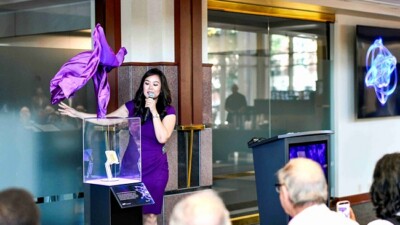
The platform combines FP64 performance, up to 144 GPUs and liquid-cooled NVL4 systems for AI, simulation and analytics.

NVIDIA has announced the NVIDIA Vera Rubin platform for scientific computing, combining native double-precision (FP64) performance, NVIDIA CUDA-X libraries and the software components of the NVIDIA AI platform.
Vera Rubin brings together NVIDIA hardware, software and scientific libraries to support AI, simulation and data-intensive research in a rack-scale system for scientific and industrial computing.
The platform is intended to support simulation, AI and data analytics workloads, including climate modeling, computational fluid dynamics, quantum chemistry and energy exploration.
According to NVIDIA, a Vera Rubin supercomputing system can provide more than 7 exaflops of AI for science, 5 petaflops of native FP64 performance and memory bandwidth across configurations with up to 144 GPUs. The company says this level of performance is intended to help research centers and industrial users run larger models, increase simulation detail and reduce processing time.
Vera Rubin for scientific computing
The NVIDIA Vera Rubin platform combines NVIDIA Rubin GPUs and NVIDIA Vera CPUs connected through NVIDIA NVLink-C2C, NVIDIA ConnectX-9 SuperNICs and NVIDIA BlueField-4 DPUs in a direct liquid-cooled architecture.
For scientific computing, Vera Rubin includes native FP64 support for simulation workloads that require numerical precision, along with AI performance for surrogate models, scientific foundation models and AI-assisted analysis. The platform is designed to support numerical solvers, AI model training and deployment, instrument data streaming and combined simulation and analytics workflows on one system.
Supercomputing system deployments
Supercomputing centers and industrial users are planning systems based on Vera Rubin for AI and high-performance computing workloads.
At the Leibniz Supercomputing Centre (LRZ), the Blue Lion system will use the NVIDIA Vera Rubin platform and second-generation exascale-class HPE Cray architecture. Scheduled to come online in 2027, the system is expected to provide about 30 times the computing power of LRZ’s current system and support research in astrophysics, environmental science and life sciences, including simulation, modeling, machine learning and surrogate model workflows.
At the National Energy Research Scientific Computing Center, Doudna, the next U.S. Department of Energy supercomputer at Lawrence Berkeley National Laboratory, will be a Dell Technologies system based on NVIDIA Vera Rubin and connected to DOE scientific instruments through the Energy Sciences Network. The system is being developed for HPC workloads, AI training and inference and data-intensive workflows in areas including molecular dynamics, high-energy physics, fusion energy, materials science, drug discovery and astronomy.
Los Alamos National Laboratory selected NVIDIA Vera Rubin, the Vera CPU and NVIDIA Quantum-X800 InfiniBand for its Mission, Vision and Veritas systems, which will be built and delivered by HPE using its Cray supercomputing platform.
Mission is intended for national security workloads. Vision, based on the Vera CPU, is intended for open science research including foundation models, AI agents and simulations in materials science, nuclear energy, fusion energy and quantum computing. Veritas, announced at ISC, will include NVIDIA Rubin GPUs and standalone Vera CPU partitions for scientific computing workloads at LANL.
The systems will be built using NVIDIA GPUs in a unified system design. NVIDIA says the NVL4 configuration is intended to support density, energy efficiency and operational simplicity for modern supercomputing workloads.
System manufacturers including Bull, Dell Technologies, GIGABYTE, HPE and Supermicro plan to offer NVIDIA Vera Rubin NVL4 in direct liquid-cooled AI and HPC racks. These systems are intended for research institutions, national laboratories and enterprises deploying rack-scale accelerated computing.
NVIDIA says the systems extend its accelerated computing platform for simulation, AI, data processing and visualization across both individual rack deployments and larger supercomputing installations.
Availability
NVIDIA Vera Rubin NVL4-based systems are expected to be available from system manufacturers in the fourth quarter of this year.
For more information, visit nvidia.com.