Now a prompt can create an AI simulation workflow, and continual large physics models will let it improve over time.
This is Engineering Paper, bringing you the latest design and simulation software news.
Nvidia CEO Jensen Huang’s dramatic ousting last week showed just how tenuous the AI industry is. The market panicked, investors sued, intelligence experts were unsurprised, and everybody else woke up to the fact that Nvidia was carrying the entire industry on its trillion-dollar shoulders. The subsequent calls to reinstate Huang, coming from both the tech industry and the White House, underlined the point.
For its part, Nvidia does not appear to want Huang back. Chair of the Board Harvey Jones (appointed as such just after Huang’s resignation) stated in an earnings call yesterday that the board “does not intend to reinstate Jensen as CEO.” That was it for comments and questions on Huang, but Jones did announce that Nvidia has now established a National Security and Export Control Oversight Committee to “enhance our engagement with the U.S. government, including all relevant agencies.”
This story is developing, but for more details on how Huang’s exit could impact engineering, read Jensen Huang’s departure raises questions about Nvidia’s industrial AI ambitions by Engineering.com senior editor Michael Ouellette.
Luminary launches Autopilot, Continual LPMs for physics AI
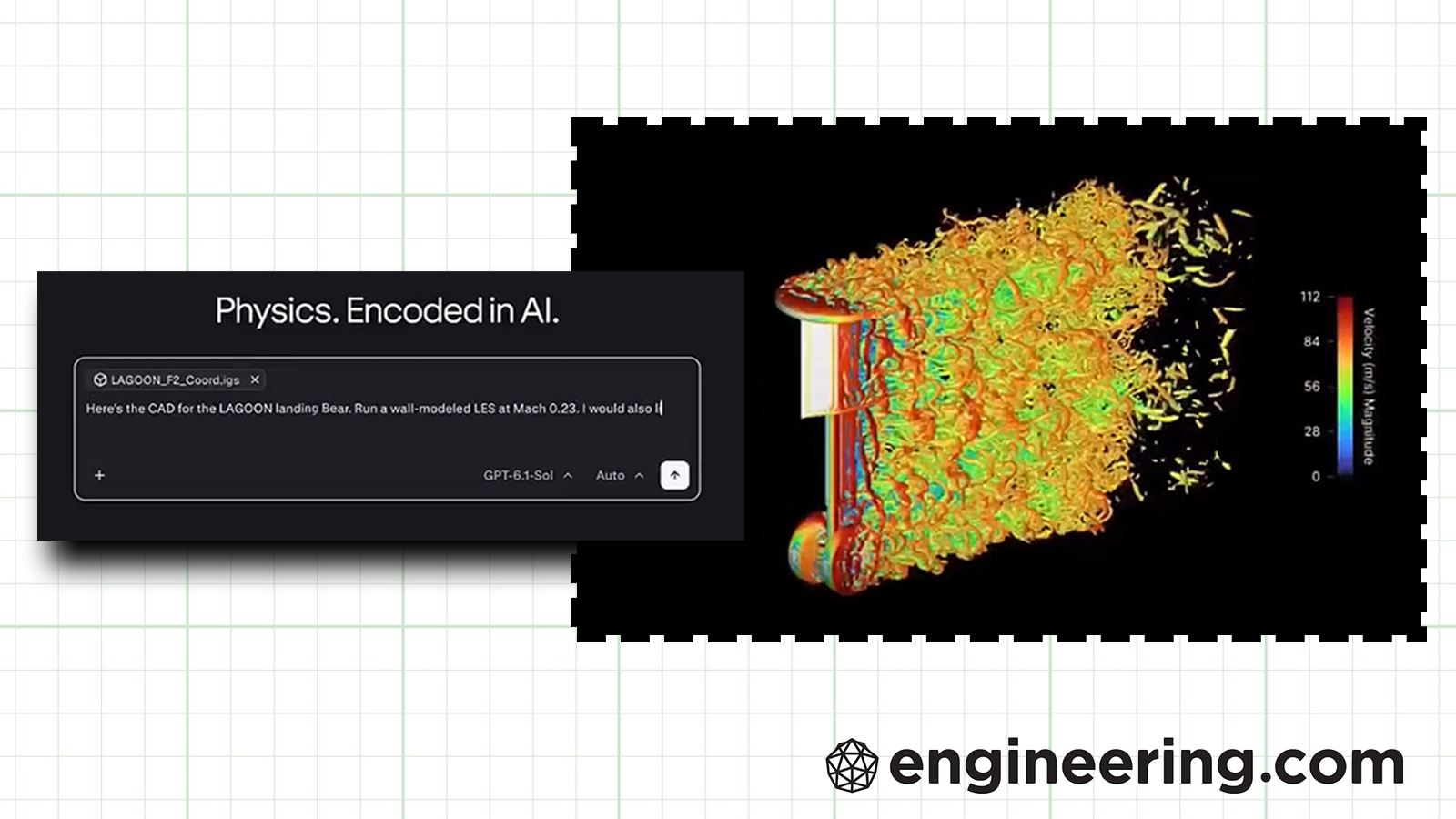
AI-based simulation developer Luminary (formerly Luminary Cloud) has launched two new physics AI solutions: Luminary Autopilot, which automates the process of building a physics AI model, and Continual Large Physics Models (LPMs), self-improving physics models that Luminary says get smarter over time.
If you’re unfamiliar with physics AI, Luminary CEO Pete Schlampp recently wrote about the topic in a contributed article for Engineering.com: AI that understands physics.
Schlampp wrote that “Physics AI, while built on similar underlying technology [as physical AI, which operates machines that act in the real world], answers a fundamentally different question: how will a physical system behave? Will a new aircraft wing generate enough lift to take off? How fast can an EV battery charge before it overheats? Will a car’s frame protect the people riding inside during a crash?”
Physics AI, then, is the type of AI that predicts simulation results, and Luminary’s new solutions aim to make it easier for engineering teams to use.
Luminary Autopilot, according to the company, can create custom physics AI workflows from a single prompt. From there, AI agents perform data generation, training, and inference using Nvidia Cuda-X and PhysicsNeMo libraries. Autopilot supports Nvidia’s Nemotron AI models and leverages the new Luminary Data Lake, a “training-ready store that indexes platform job data, third-party simulation data and reference dataset, so that customers can train or fine-tune agents against existing data and public baselines, as well as their own data,” according to Luminary.
Continual Large Physics Models aim to overcome the limitations of current LPMs, which Schlampp describes as the core technology of physics AI.
“An LPM,” Schlampp wrote, “learns the patterns of physics from thousands of physics-based simulations and then predicts how a new design will behave without solving the equations from scratch. Train an LPM on enough examples of how air flows over a wing, how heat moves through a battery, how metal bends in a crash, and it can be used to predict the behavior of a new object in a fraction of the time and cost of the traditional approach.”
The problem is that once the LPM is trained, it’s static, and must be retrained to adapt to new data. Continual LPMs, Luminary says, “get smarter simply by being used. The models autonomously improve themselves without retraining from scratch and without human initiation, identifying their weaknesses, generating the data needed, and learning from that data without forgetting existing knowledge.”
Both Autopilot and Continual LPMs will be available in Luminary’s Fall 2026 release. You can read more about them on Luminary’s release post.
Quick hits
- SimScale has released the Engineering AI Blueprint, a reference architecture for scaling AI agents. The document “sets out the layers an engineering organization needs so that agents can do real engineering work, from the earliest concept through to a validated design,” according to SimScale. The architecture includes several Nvidia technologies, among them Omniverse and PhysicsNeMo, alongside SimScale’s cloud simulation platform.
- Chipmaker AMD has completed its acquisition of World Labs, an AI company focused on spatial intelligence and generating 3D environments. The all-stock transaction is valued at approximately $8.2 billion.
One last link
The year that voters asked “can you hear us now?” by Miles Budimir for Design World.
Got news, tips, comments, or complaints? Reach me at [email protected].
For more industry news and analysis, subscribe to Engineering.com’s weekly newsletter.