Additive manufacturing’s near-term growth may be driven more by suppliers than OEMs.
We started with the promise of a 3D printer in every home and, when that didn’t pan out, 3D printers in every factory. Nowadays, if we’re talking about volume production—the difference between 3D printing and additive manufacturing (AM)—some of the best examples can be found in large contract manufacturers and small job shops.
That naive prediction that traditional manufacturing machines for milling, turning, stamping, molding, etc. would all be replaced by row upon row of industrial 3D printers may not have been so far off the mark after all. The mistake was in the assumption about where this transformation would take place, because it’s not the OEMs that are driving the future of AM growth—it’s their suppliers.
“Service providers are outrunning the market”
Of course, large contract manufacturers like Protolabs and manufacturing marketplaces like Xometry have been around for years. But there are also more recent examples: younger manufacturing service providers that have been growing rapidly thanks to a combination of pressure to reshore supply chains and the availability of more affordable industrial 3D printers. Take ADDMAN, for example.
Founded in 2020, the company now has nine locations across the United States and, just last week, ADDMAN committed to investing in 81 additional 3D printers from HP. That’s one of the largest sales in the history of HP Additive Manufacturing Solutions and it’s from a relatively new, relatively small (but rapidly expanding) manufacturing service bureau. “Service providers are outrunning the market,” says François Minec, global VP of sales and business development for HP Additive Manufacturing Solutions. “When we look at the demand on our printers, the service providers are growing at double the rate of the rest of the market. For us, that’s a very good sign that the market is maturing.”
Minec sees an analogy here between AM and injection molding: while many OEMs (including HP) incorporate injection-molded plastic parts into their products, the majority don’t own their own injection molding equipment. By the same token, the expectation is that the number of 3D printed parts in production applications—both end-use parts and jigs, fixtures, and tooling—will significantly outpace machine sales.
HP Additive’s own data supports this prediction, with service providers growing by 15% in 2025 even as machine sales remained flat that same year. The claim is that this indicates service providers were absorbing the existing demand in 2025, but machine sales have rebounded this year, as evidenced by deals like the one between HP AM and ADDMAN. Minec also cites data from the market intelligence firm CONTEXT, indicating that industrial 3D printer sales are up 23% year-over-year in 2026.
Whither MJF 1200?
It’s clear that manufacturing service providers are the key market for HP’s 3D printing business unit. Indeed, the company has deliberately eschewed creating its own service bureau (along the lines of Stratasys Direct) to avoid competing directly with its best customers.
What’s less clear is how and where HP’s latest advancement in multi jet fusion (MJF) 3D printers, the MJF 1200, fits into this strategy. Announced at RAPID + TCT this year, the MJF 1200 is the “entry-level” multi jet fusion 3D printer with a price tag in the region of $60,000. Designed to run on standard electrical connections and with basic environmental controls (no dedicated exhaust system, minimal PPE), it’s meant to be an industrial system without industrial requirements. It’s a tantalizing proposition, but it also seems to run against the idea of contract manufacturing as the most fecund ground of AM growth.
“It’s a great idea, but we’re probably not the intended target market for it,” says Keith Schneider, general manager of ADDMAN. So, if it’s not aimed at service bureaus and OEMs have already been ruled out, what does that leave for the MJF 1200?
According to Marc Garcia Grau, product manager for 3D printing at HP, the ideal MJF 1200 user is someone who will use it for ten percent of their time. “Imagine a university or a small design firm,” he explains, “places where you spend ten percent of your time working with a printer and then you move on to other things.”
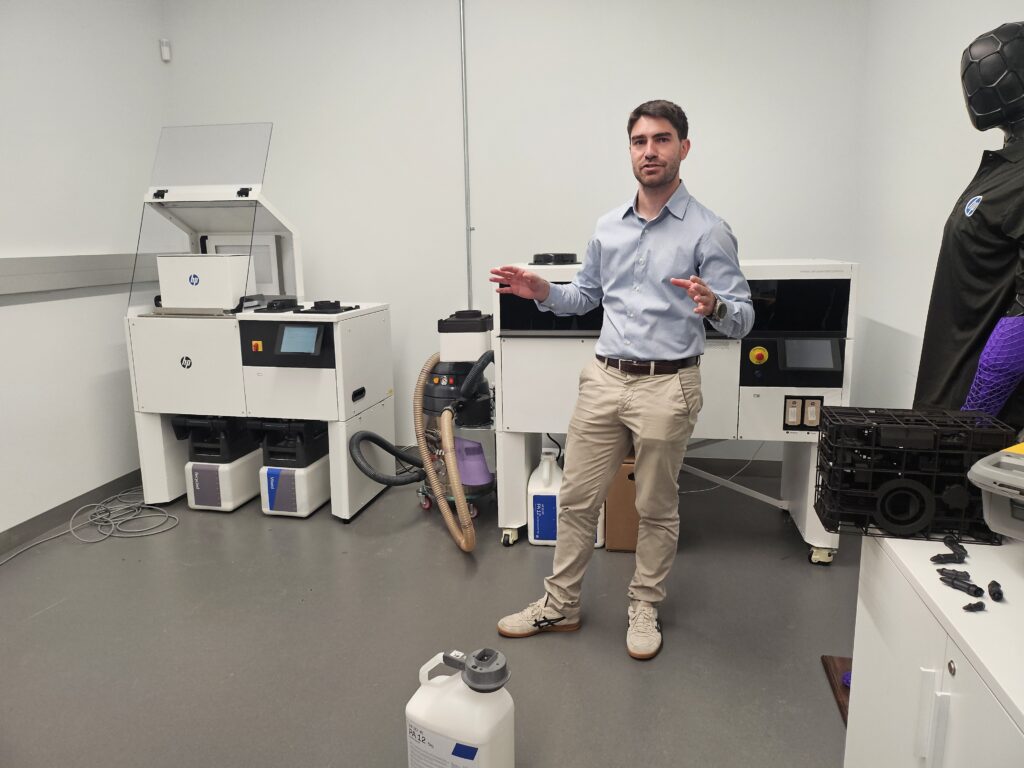
Alex Moñino, SVP and general manager of HP Additive Manufacturing Solutions, expands on this point by emphasizing differing personnel requirements for his company’s AM offerings:
“In an industrial environment, like at ADDMAN or Streamline 3D, there are professional operators whose job is to run the printers. Where we’re trying to go with the 1200 is design environments. We want design engineers to have access to MJF but it’s not going to be their primary job, and there isn’t going to be a dedicated operator to run the machine.”
In other words, rather than seeing the MJF 1200 as aiming to be the first step on the road to industrial AM, it may be better to think of it as filling in the demand gap between desktop fused filament fabrication (FFF) machines—a segment that’s become dominated by the likes of Bambu Lab and Creality—and industrial-scale AM. Of course, that’s not to say that aspiring AM business owners couldn’t start with an MJF 1200 and contract out to larger bureaus until they can afford the larger industrial machines to scale their production. That would more likely be the exception than the rule, however, as Garcia acknowledges that the MJF 1200 “will likely be the most expensive printer they have.”
Compared to the price of a large-volume industrial 3D printer, $60,000 is a bargain, but wouldn’t someone who’s already running a fleet of desktop units in a printer farm prefer to get another 25 or 30 of those over one MJF 1200?
Clara Remacha Corbalán, head of product management for HP 3D printing polymers, believes the real deciding factor would be functionality. “There’s always a reason why you get into powder,” she explains. “And that reason is always that the parts you’re getting out of a Bambu are not good enough for what you need. If what you’re printing is good enough with a Bambu, most likely you will not get into powder but, for most applications, at some point you’re going to need powder-bed technology.”
The future of industrial 3D printing
AM’s growth in contract manufacturing is more than mere business strategy on the part of AM suppliers. There are clear benefits to deploying 3D printing in the inherently nimble environments of service bureaus and job shops. As a technology, 3D printing makes elastic production capacity much more viable, since it obviates the need for cumbersome and/or expensive molds and tooling.
“If you’re a manufacturer with your own MJF machines, you can overflow to the contract manufacturers by sending them the same build and you’ll get the same parts from them that you’re getting from your machines,” explains Brian Ingold, head of applications and business development at HP Additive Manufacturing Solutions. “It allows you to scale up and scale down based on need or demand.”
Of course, that requires consistency between machines that may be hundreds of miles apart. Compared to more conventional forms of manufacturing, such as machining or injection molding, consistency has not historically been 3D printing’s strong suit. That’s why, according to Moñino, HP Additive Solutions aims to ensure consistency through process development using AI to calibrate its printers. “We can ensure that the output of the parts is consistent with the tolerance, the distribution of the tolerance, et cetera,” he says.
Beyond AI, which is practically a prerequisite for any forward-looking strategy these days, the future may well be shaped by manufacturing service bureaus printing parts for the next trending technology: humanoid robots. “We see parts for every humanoid robot being printed at service bureaus,” Minec says. “Most of those companies have their own printers for internal development, but they’re also sending orders to service bureaus, and I think most of the humanoid robot companies are using MJF.”