Technology talks, new product announcements, and insights from the Industry & Application Stage.
Another Formnext is upon us and I am, once again, covering the event remotely.
Before diving into some of the major announcements and highlights from the Industry & Application Stage livestream, I’d like to introduce a new feature of this year’s coverage: Remote Regrets.
Formnext, like most industry events, includes presentations by exhibitors and attendees. In this case, they’re divided between two stages: The Industry & Application Stage, which is livestreamed, and The Technology Stage, which is not. But even though I’m unable to attend the Technology Stage presentations, I couldn’t help perusing the session titles and abstracts, so here’s a short list of the Technology Stage presentations I wish I could see.
Remote Regrets
Title: Standing Up an Additive Manufacturing Capability – Lessons Learned
Time: 11:30-11:45am (GMT+1)
Presenter(s): Mike McNair, VP for Aerospace with SAE ITC & President of SAE Government Technologies
Reason for Regret: Although we tend to put desktop 3D printers and industrial additive manufacturing (AM) systems in the same technology bucket, there’s an enormous gulf between running a desktop printer farm and operating large metal AM machines. This session promises to dig into the details of making the transition from one to the other based on first-hand experience, which is always a rare and valuable commodity in trade journalism.
Title: The First Layer: From Rapid Prototyping to Additive Manufacturing and Beyond
Time: 3:45-4:00pm (GMT +1)
Presenter(s): Chuck Hull, co-founder and CTO, 3D Systems; Patrick Dunne, SVP & technical fellow, 3D Systems
Reason for Regret: I’m a sucker for the history of technology, and what better way to appreciate the origins of 3D printing than a presentation from one of its originators? Based on the abstract, this is a fireside chat between Hull and Dunne that aims to span the entire 40-year history of 3D printing in just 15 minutes. Ambitious and intriguing!
Title: Text-to-Code-to-CAD: The Future of AI-Driven Engineering
Time: 4:15-4:30pm (GMT+1)
Presenter: David Nguyen, senior technical services engineer, Onshape by PTC
Reason for Regret: I saw Nguyen speak at last year’s Formnext as part of a panel called “What does AI mean for design for additive manufacturing (DfAM)?” where he presented a highly optimistic view of the future of AI and engineering. Based on the title and abstract of his session for this year, that optimism has persisted but it’s also tempered with some practical advice about working with agents embedded into cloud-native platforms. With all the flash around AI, it’s heartening to see the promise of some substance as well.
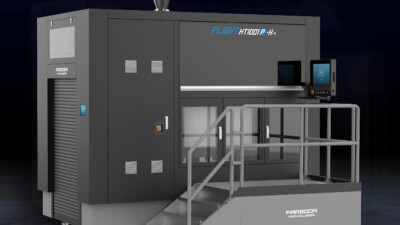
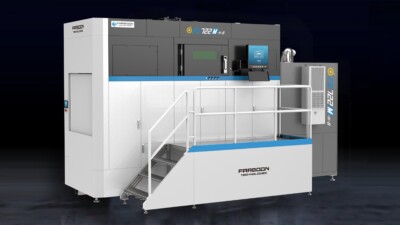
Title: Advancing Industrial AM: New Systems, New Possibilities from Farsoon
Time: 4:45-5:00pm (GMT+1)
Presenter: Eric Chen, senior product engineer, Farsoon Europe
Reason for Regret: A lot of the action in 3D printing and AM these days seems to originate in China, with more and bigger booths from companies such as BLT, Farsoon, and others appearing in Western tradeshows. Despite that growth—both in show floor footprint and market presence—these companies run relatively quiet compared to their Western counterparts. That’s why, despite the complete lack of an abstract, this presentation from a Farsoon engineer is one I’m truly sorry to miss. (Honorable mention for the Anycubic x Thingiverse session, which is similarly scant on details.)
Product Announcements
Nikon SLM Solutions MACHX
Nikon SLM Solutions has announced a new family of laser powder bed fusion (L-PBF) metal 3D printers designed for series production. The MACHX series offers three build envelopes:
- MACHX 450: 450 x 450 x 450 mm
- MACHX 450C: 450 x 600 x 450 mm
- MACHX 450E: 450 x 450 x 1000 mm
According to the company, the MACHX 450 is intended for general manufacturing, the 450C for automotive components and other long, flat parts, and the 450E is for tall components, such as rocket engine thrust chambers. Although they differ in build volume, the printers share the same platform and software.
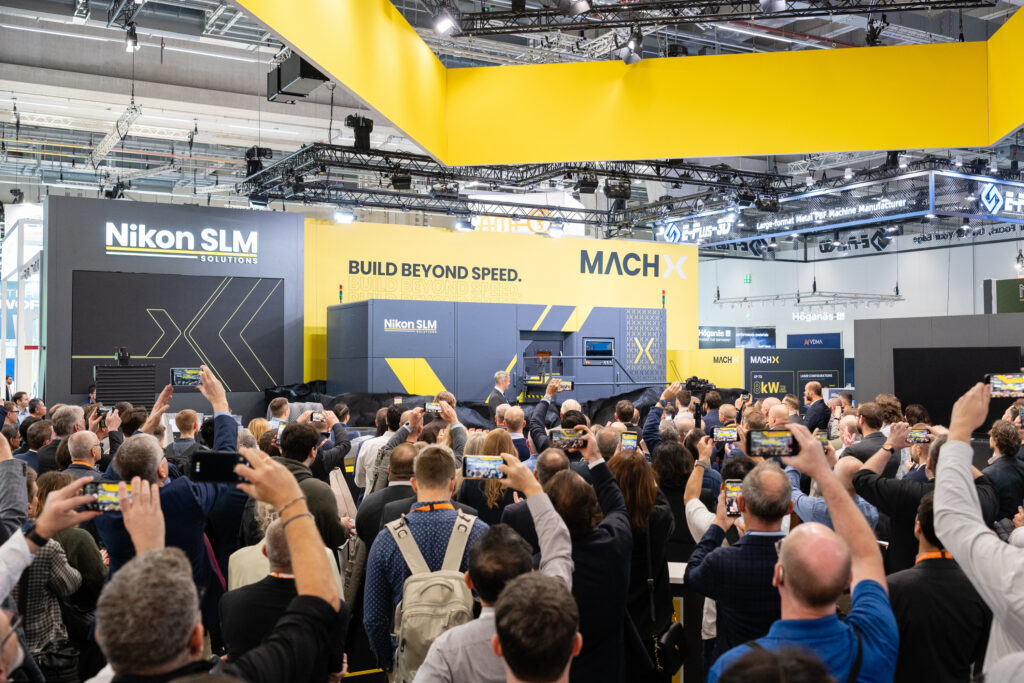
The machines can be equipped with up to 8 kW of total laser power: four or eight 1 kW Gaussian lasers or four 2 kW lasers with selectable beam-shaping options.
An optional cylinder exchange preheats the next cylinder outside the build chamber while the current job is running, and interfaces for automated material handling and shared depowdering are designed to allow multiple systems to work as a single production cell.
“Customers are no longer asking whether additive manufacturing is possible,” said Sam O’Leary, Nikon SLM Solutions CEO, in a press release. “They are asking how fast it can run, how reliably it can perform, and how confidently it can scale. MACHX is our answer to all three. It is built for the parts most of the industry actually makes, and for the factories that need to make many more of them.”
MACHX is on display at Formnext in Hall 12.0, Booth D119.
Stratasys H550 and PowderEase T2
On the polymer side, Stratasys has announced a new SAF 3D printer, the H550, which features a 34.2-liter build volume and 450 mm long axis. According to the company, it’s designed to complement the existing H350 by extending SAF technology into applications requiring larger parts or greater production volumes. Stratasys claims the H550 can deliver up to 30 percent lower total cost of ownership compared to similar print-and-fuse systems.
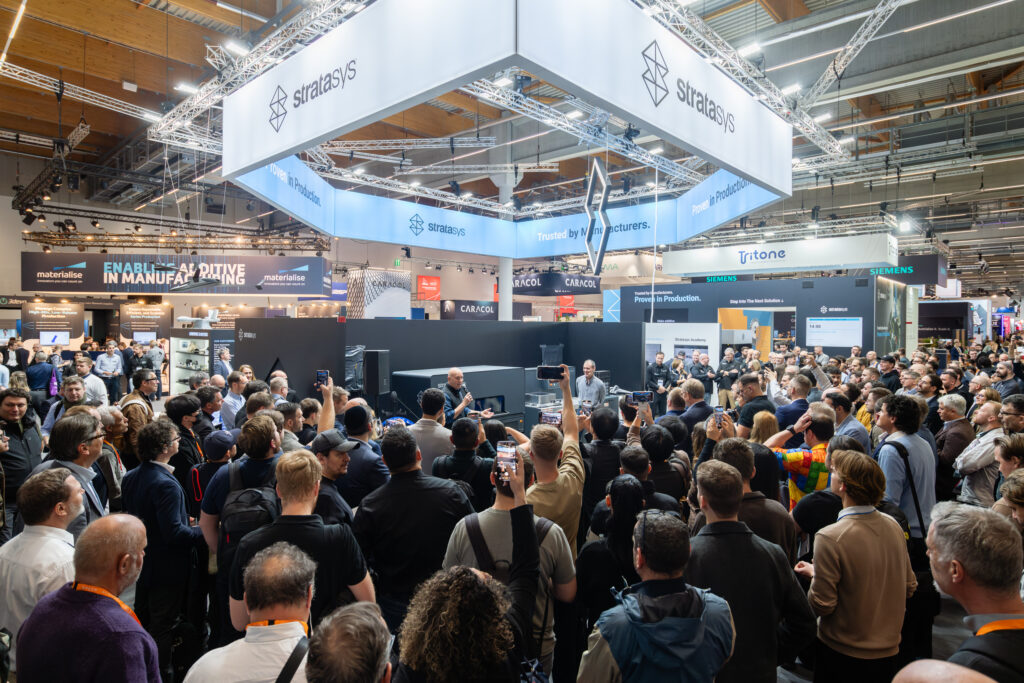
“Manufacturers choosing a production system are making decisions that will shape their operations for years,” said Rich Garrity, Stratasys Chief Business Unit Officer, in a press release. “Before committing to their next powder bed fusion investment, they should see what the H550 can do. It brings greater capacity, larger parts and more attractive production economics designed to scale, so more applications can move onto the factory floor.”
The company also introduced a new automated powder handling workflow for the H550, the PowderEase T2, which is designed to handle breakout, powder retrieval, sieving, and dosing. A single PowderEase T2 system can support up to six H550 machines running the same material, and Stratasys says that the production workflow requires less than 30 minutes of total operator time per build.
Both systems are on display in Hall 12.1, Booth D129.
From the Industry & Application Stage
The livestream of the Industry & Application Stage at Formnext is the best way of experiencing the show remotely, at least until someone offers telepresence via humanoid robots. The first day of the show offered several interesting presentations on topics ranging from closed-loop process chains for AM aerospace components to how AI can accelerate AM workflows, as well as the always engaging Pitchnext Event for startups.
(More on that last one later this week when the winners are announced.)
For me, the highlight was the discussion about the state of the AM industry in 2026, which featured experts from Wohlers Associates, Renishaw, and VDMA, among others. Moderator and fixture of the Industry & Application Stage, Sven Krause, ushered the panelists through a wide range of topics, including supply chains, AM market growth over the last year, and (of course) AI.
On the subject of AM supply chains, Ross Trepleton, director of component manufacturing at the UK’s MTC, pointed out a “chicken-and-egg” problem with supply chains in the UK that would likely ring true for suppliers around the globe:
“The technology has advanced, so where we see the challenge now is much more commercial. We have lots of organizations in the UK who want to invest more in additive but they really struggle to get a clear demand signal. Then you have the industrial primes saying, ‘We want a qualified supply chain,’ which takes a lot of investment for organizations to get to. Suppliers want to invest in growing demand, but the primes don’t want to overcommit to what their demand signal is going to be.”
Despite this sort of supply chain challenge, Mahdi Jamshid, director of market intelligence at Wohlers Associates, remained optimistic about AM market growth, although he also noted a distinct difference between metals and polymers:
“Imports of metal machines [to the United States] in the first six months of this year increased by 64 percent. On the polymer side, 77 percent of imports to the US so far this year have been from China. China’s participation on the metal side is very slim: about 1 percent. You can probably guess why.”
On the subject of AI and specifically whether all of the industry attention on the technology is pulling focus away from AM, Rainer Lotz, president EMEA for Renishaw, sees more opportunity than conflict:
“When we look at our AM systems, we have so many methods for analysis and an enormous amount of data. With AI, now we gain the possibility of making something out of it and improving productivity and results. I don’t think these technologies are in competition; I think they’re well aligned.”
There were plenty of other insights to be gained from the panel discussion, as well as the rest of the Industry & Application Stage livestream, so be sure to check out the whole of Day 1 and tune in again tomorrow for more from Formnext 2026.