Technology talks, new product announcements, and insights from the Industry & Application Stage.
It’s the second day of Formnext and my remote coverage continues, fortunately sans jetlag but also unfortunately sans schnitzel. Before we get to the major product announcements and highlights from the Industry & Application Stage livestream, here are the talks from the Technology Stage I’m most sorry to miss.
Remote Regrets
Title: Beyond Design Freedom: Managing the Engineering Complexity of AM
Time: 12:00-12:15pm (GMT+1)
Presenter(s): Jonas Keller, head of the Competence Center AM Design, cross-ING AG
Reason for Regret: There’s a tendency in additive manufacturing (AM) to tout the benefits of 3D printing technology while downplaying the trade-offs that come with them. Design freedom is usually one of the first bullet points on the list of reasons to love AM, but the challenges that come with it are often framed in terms of an educational burden for the user (i.e., design for additive manufacturing). This session promises to help engineers manage the added complexity that comes with design freedom from a practical perspective.
Title: The Nadcap aerospace accreditation program for AM suppliers
Time: 12:45-1:00pm (GMT+1)
Presenter(s): Richard Freeman, principal staff engineer AM, MMM & HT Task Groups, PRI
Reason for Regret: As I learned during my research for a webinar earlier this year, the standards and certifications for AM in aerospace manufacturing are incredibly complex. I didn’t even touch on Nadcap then, so if I had the opportunity to attend this session on Nadcap AM program developments and updates from this year’s Task Group meetings, I’d jump at the chance to learn more. Ideally, it would come with a preview of the audit criteria for cold spray and fused filament fabrication.
Title: The Ultimate Additive Quiz Show
Time: 5:15-6:30pm (GMT+1)
Presenter: Joel Telling, host, 3D Printing Nerd
Reason for Regret: While I must admit that the very concept of 3D printing influencers makes the burgeoning grumpy old man inside me recoil in horror, I can’t deny Joel Telling’s on-camera presence and I’ve no doubt it would make him an excellent game show host. I’m also a big fan of trivia in all its forms, and the fact that this paid event is donating its proceeds to the Sanjay Mortimer Foundation makes it an even more regrettable miss.
Product Announcements
3D Systems MJP 300
‘Polymer printing for production’ seems to be the watchword (er, phrase) at this year’s Formnext, with 3D Systems announcing a new addition to its multijet printer line-up: the MJP 300. The new machine features a 294 x 211 x 144 mm build volume, which the company says can be divided into three lanes, grouping similarly sized parts together for greater productivity. At the highest resolution, the MJP 300 can produce parts with 16 micron layers at 1600 x 900 dpi.
“The MJP 300 represents a new generation in multijet 3D printing,” said Martin Johnson, 3D Systems VP for product and technical fellow, in a press release. “Updated electronics and software provide a new level of accuracy, surface finish, ease-of-use and security for our customers with a platform that can scale.”
The MJP 300 is on display in Hall 11.0, Booth D11.
EOS Helior
Another major polymer reveal from the show, EOS has unveiled a new large-format AM machine aimed squarely at production applications. According to the company, the EOS Helior can process a 154-litre build at 10 percent packing density in a 24-hour cycle. It has a build volume of 700 x 380 x 580 mm and incorporates three 70W lasers. It’s launching with validated material process parameters for PA 2200 and PA 2220 HighReuse materials and it’s designed to integrate into the EOS ecosystem. The company says the system was developed in collaboration with five pilot customers, including Materialise and Shapeways.
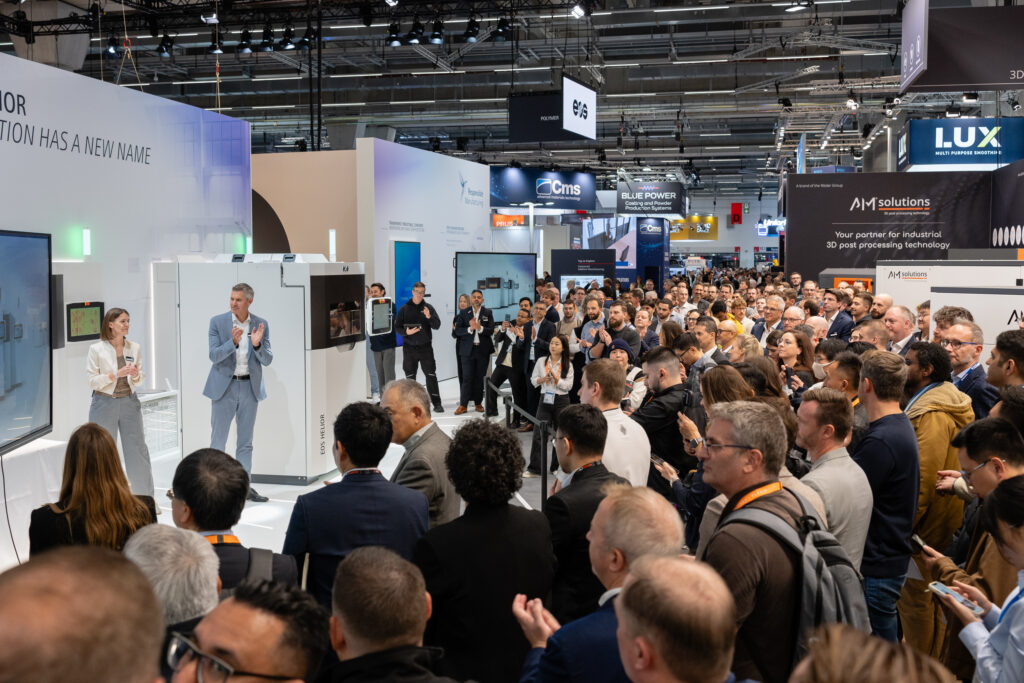
“With EOS HELIOR, we focus on the production challenges our customers face every day: throughput, flexibility and reliability,” said Joachim Zettler, EOS CTO, in a press release. “EOS HELIOR improves the economics of the entire production workflow, supporting a full week of build jobs and more than 1,000 liters of production before maintenance operations. Less post-processing and labor, integrated monitoring, open data access and reduced maintenance contribute to greater efficiency and predictability, helping manufacturers scale production with confidence.”
The EOS Helior is on display in Hall 12.0, Booth D71.
From the Industry & Application Stage
It’s difficult to sum up the entirety of the Industry & Application Stage livestream, so rather than trying to run through all of the talks from Day 2, I want to focus on one in particular: WILDWOOD: Where Artistry and Technology Take Flight to create a Stop Motion Epic. Featuring Brian McLean and Rob Ducey from LAIKA, which is probably best known as the production company behind the 2009 film Coraline, the talk focused on an under-appreciated application of 3D printing (at least from an industrial perspective).
What struck me was the emphasis on the artistic capabilities 3D printing enables for stop motion animation. The studio’s latest project, Wildwood,involved the production of over 142,000 individual faces for the characters, which the animators then swapped on physical puppets frame by frame, with up to 24 faces used for a single second of footage. Other 3D printing applications included expressive coyote ears, replacement sequences for water and whipped cream, and even fur printed on custom flexible skins.
The most surprising thing about the film is that it ended up being a kind of specialized AM case study. “One of the challenges with our process is that we are kind of mass-producing parts using 3D printing, but by design, each one of our mass-produced parts is unique,” said McLean.
Honestly, I’d never heard of Wildwood before seeing this session, but learning more about the process of making it has definitely piqued my interest. I did not expect to get a film recommendation out of Formnext, but that’s the great thing about live events, even when you’re attending remotely.
There was plenty more to see on the Industry & Application Stage livestream, so be sure to check out the whole of Day 2 and tune in again tomorrow for more from Formnext 2026.