The ASR-D501 delivers up to 12 TOPS in a sub-10W design with multi-camera and sensor connectivity.
Advantech announced the ASR-D501, a compact AI companion and mission computer designed to accelerate the development of autonomous unmanned aerial vehicles (UAVs).
Powered by the Qualcomm QCS6490, the ASR-D501 delivers up to 12 TOPS of AI performance within a sub-10W power envelope, while integrating multi-camera vision, sensor connectivity, flight-controller interfaces, wireless expansion, and the Advantech Robotic Suite for Drone.
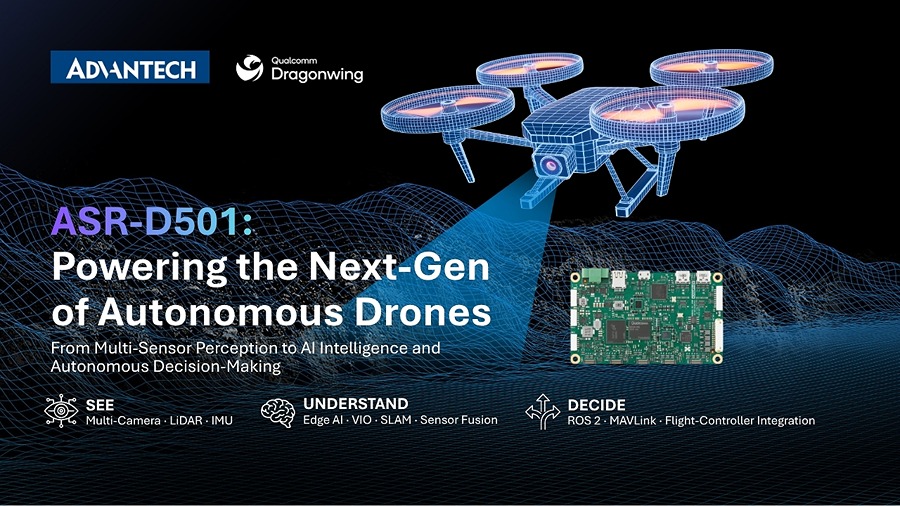
Designed specifically for size-, weight-, and power-constrained airborne applications, the ASR-D501 provides a unified computing platform for real-time AI inference, visual perception, localization, sensor fusion, and mission-level processing. It supports advanced autonomous capabilities including object detection, visual localization, VIO, SLAM, obstacle awareness, and GNSS-denied navigation.
Power-efficient AI computing for autonomous UAVs
The Qualcomm QCS6490 combines heterogeneous CPU, GPU, and NPU computing to enable AI workloads to run directly onboard the drone.
By processing perception and mission-level workloads locally, the ASR-D501 reduces reliance on continuous cloud connectivity while allowing the primary flight controller to remain focused on real-time flight stabilization and actuator control.
Supported AI workloads include:
- Object detection and tracking
- Semantic segmentation
- Visual inspection and anomaly detection
- Obstacle awareness
- Vision-based localization
- Sensor-fusion processing
Multi-sensor perception and fexible connectivity
To support increasingly sophisticated UAV perception systems, the ASR-D501 integrates five 4-lane MIPI-CSI interfaces, enabling flexible combinations of RGB, monochrome, stereo, and high-resolution cameras.
The platform also provides a 2.5 GbE interface, two USB 3.2 Gen 2 Type-C ports, and onboard interfaces including CAN FD, UART, I2C, and GPIO for connecting LiDAR, depth cameras, IMUs, flight controllers, ESCs, battery-management systems, and other onboard devices.
For long-range and BVLOS-oriented deployments, the ASR-D501 supports Wi-Fi 6E, Bluetooth, and 4G/5G cellular connectivity through M.2 expansion, together with an onboard Nano-SIM. This enables flexible communication architectures for telemetry, command and control, video transmission, and remote mission management.
Accelerating development with Advantech Robotic Suite for drone
The ASR-D501 supports Ubuntu 24.04 LTS and the Advantech Robotic Suite for Drone, providing a pre-integrated development environment for autonomous UAV applications.
The software environment connects high-level ROS 2 applications with flight-controller ecosystems including PX4 and ArduPilot, leveraging technologies such as MAVLink, MAVSDK, and MAVROS.
Advantech also provides validated reference workflows that integrate AI perception, visual localization, sensor fusion, mapping, object tracking, path planning, and flight control. By providing a connected software and hardware foundation from perception to flight-control integration, the ASR-D501 helps developers reduce integration complexity and move faster from hardware bring-up to autonomous-flight application development.
Built for production UAV deployment
The ASR-D501 is engineered to meet the practical requirements of industrial UAV deployment with a compact, fanless design and industrial-grade reliability.
Key specifications include:
- 100 × 60 mm compact form factor
- Approximately 50g board weight without heatsink
- 5–12V DC input
- Passive / fanless thermal design
- -20°C to 70°C operating temperature
- 3.5 Grms vibration resistance
- Industrial-grade ESD protection
- Lockable connectors
- Long-term product lifecycle support
Expanding Advantech’s UAV computing portfolio
The ASR-D501 is part of Advantech’s broader strategy to build a scalable computing portfolio for increasingly diverse UAV architectures and mission requirements.
Beyond the QCS6490-based ASR-D501, Advantech’s UAV roadmap includes OSM- and SMARC-based SOM solutions for flexible system designs, as well as IQ9075M-based platforms for applications requiring higher AI performance and advanced sensor integration. In 2027, Advantech plans to further expand the portfolio with mid-range Qualcomm CQ8-based solutions.
By combining scalable computing platforms, robotics software integration, sensor ecosystem support, and long-term industrial lifecycle management, Advantech aims to provide drone developers with a clear path from autonomous-flight prototyping to increasingly intelligent and production-ready UAV systems.
For more information, visit advantech.com/asr-d501-grand-launch.