Georgia Tech student collaborates with Protolabs in attempt to break a world speed record.
Like so many great engineering stories, this one starts with something broken.
It began when Tomas Salvo, an aerospace engineering senior at the Georgia Institute of Technology, discovered an old turbine engine in one of the labs on campus. “It wouldn’t start because of a faulty igniter,” he recalls. “I had worked on small microturbines like it during an internship the previous summer.”
Salvo asked the club that owned the turbine for permission to repair the engine and put it into an RC plane of his own design. Incentivized with the promise of being included in the design review, the club agreed and Salvo spent the next month fixing the engine before designing the first version of his plane, Reaper, to incorporate it. That was the beginning of a journey that would lead Salvo on a quest to break the world record for fastest remote controlled plane, achieving 491mph on October 27, 2026.
Of course, there were many more hurdles to overcome before he got there.
RC enthusiast turned engineer
“I’ve been an RC kid since I was eight years old,” Salvo says. “I started building remote-controlled planes with foam I cut into pieces to make the wings and buying small components. That progressed into 3D printed aircraft and, eventually, I made the world’s fastest remote-controlled plane, Reaper.” As he describes it, 3D printing seems to have introduced a step-change in Salvo’ hobby, and today he owns multiple desktop machines.
He used one to create a scale model of his initial design for Reaper, flying it with an electric ducted fan to verify the aerodynamics and flight controls. When he posted the project on LinkedIn, Salvo says it went viral and prompted the school club to ask for the turbine engine back, both for liability reasons and for use in a different project.
Chagrined but undeterred, Salvo began reaching out to companies, seeking sponsorship for a new engine in exchange for featuring their logos on his finished project. With virality on his side, he managed to gain sponsorships from Anduril, AutomationDirect, JetCat, and—most significantly for this story—Protolabs.
Machining and fabricating vs additive manufacturing
Justin Sawyer, applications engineer at Protolabs, grew up around machining. “My dad was a machinist and he had a business for a while,” he explains. “So I got into it that way and I really liked the problem-solving side of things: machining parts and figuring out how to fixture them. It’s ironic, because you don’t have to deal with that as much in 3D printing, although if you’re doing post-machining with DMLS [direct metal laser sintering] it can be more complex because the parts can be shaped however you want them to be.”
His machining background led Sawyer to work at Protolabs, initially running post-process machining before transitioning into additive manufacturing (AM) and especially DMLS as an applications engineer. It was in this role that he first encountered Salvo’s project, specifically one particular part: a custom titanium nozzle extender for a mini turbine engine.
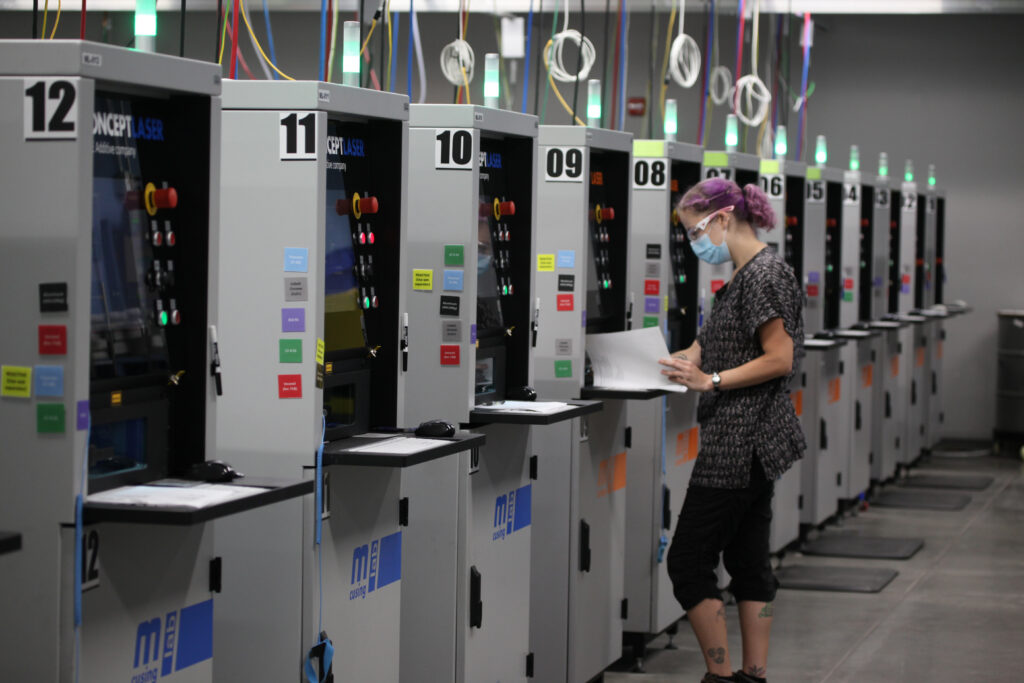
“We have a service where customers can request a design review,” Sawyer explains. “Typically, we go over build risk, potential modifications to help parts build or function better, go over tolerances, that sort of thing. Tomas’ component was already well designed for DMLS, so mostly we went over potential warping risks, critical dimensions, some thin features, like where the nose cone tapers to almost zero thickness.”
As Salvo recalls, most of his design iterations occurred before connecting with Protolabs, largely driven by flow simulations of the engine exhaust. “Getting the expansion right was critical,” he says. “And making sure the exhaust wasn’t restricted, which could cause the turbine to blow up.” Ultimately, the biggest adjustment Sawyer suggested was the wall thickness, which ended up being roughly 0.6 mm. “It turned out totally fine,” Salvo recalls. “But I remember Justin warning me, ‘Dude, this thing could still break because it’s really thin!’”
Although Salvo considered other manufacturing methods—such as rolling a thin sheet of Inconel and welding it—he concluded that DMLS was the best option for the sake of precision and design freedom. The sheet metal method would have resulted in weld seams that could have impacted aerodynamic performance, and the nozzle also includes an internal plug designed to reduce flow separation behind the turbine blisk which could not have been fabricated with sheet metal. They also ruled out CNC machining because it wouldn’t have been able to achieve the required wall thickness.
“Those other methods probably would have taken a lot of time,” Sawyer says. “We were able to print this part pretty quickly, and that’s why a lot of aerospace parts are moving to DMLS: because it’s quick.”
Challenges and words of advice
According to Salvo, the most difficult part of this project was tooling, specifically the composite molds for the aircraft’s carbon-fiber skins. “It’s really brutal to make one-off molds by yourself,” he says. His approach involved four sheets of ¾-inch MDF, “about a gallon of glue” and roughly 500 pounds of weights from the Georgia Tech shop. “I cut each of the molds with a CNC router, then sealed them with wood sealer, and every single detail had to be perfect, or you end up with bridges in your carbon fiber and lose performance. But everything else was fun.”
On the manufacturing side, Sawyer had difficulty recalling any particular challenges, citing Protolabs’ experience producing aerospace parts and a design that was already well suited to DMLS. “We do this over and over every day,” he says. “Once everything is set in the beginning, we can just go through our process and ship out a good part.”
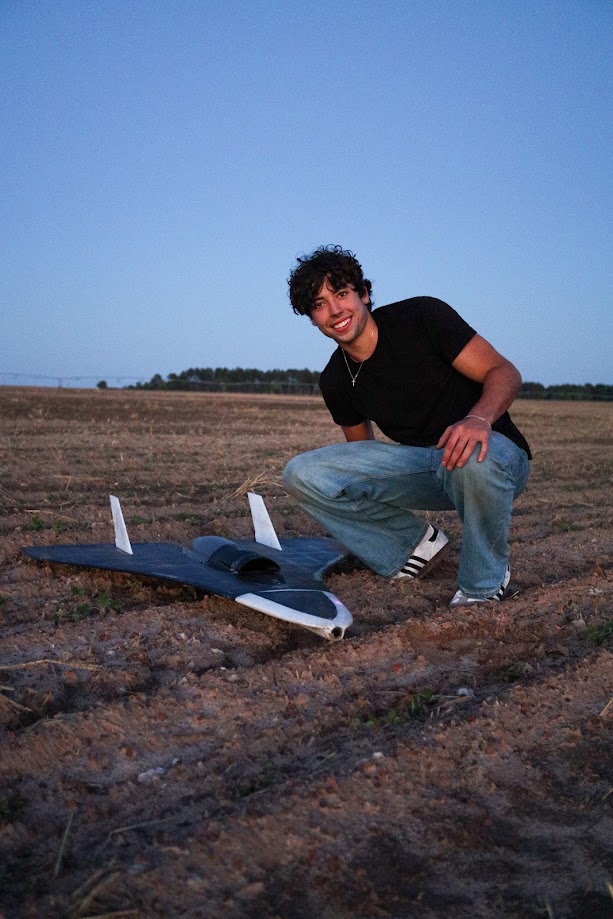
Indeed, the project has turned out so well for Salvo that he’s already working on a supersonic unmanned aerial vehicle (UAV) and starting a company to commercialize his designs. Asked what advice he would give to any young or aspiring engineers who might be feeling inspired by Reaper, Salvo offered the following:
“Honestly, get your hands on stuff: get a 3D printer and just start making things. Even if you don’t have the confidence to start your own project, just do something from YouTube; there’s so many cool tutorials for 3D printed RC planes, and the more you do, the more you learn.”