3D printed infrastructure updates from the U.S. Army, Concordia University, ICON, and ETH Zurich.
At a recent industry event, I got into a conversation with an analyst from a market intelligence firm on the subject of 3D printing in construction. He told me that while he and his colleagues monitor the additive manufacturing (AM) industry closely, they aren’t particularly interested in AM for construction. Why not?
Well, to paraphrase him, it’s because construction 3D printing is the black sheep of AM.
That characterization has stuck with me partly because I think it’s true, but mostly because I’m unsure of why it should be. Is it a matter of scale? Or industry?
At least in principle, the technology isn’t so different from the ones you’d find in Additive Manufacturing Technologies. Yet even that textbook—comprehensive as it is—doesn’t discuss additive construction.
To be fair, we’ve only covered 3D printing in construction sparingly over the years here on engineering.com, typically when it comes up in a specific niche, or if there’s a notable breakthrough in research, or if we connect with an expert who can offer some unique insights. While I can’t promise that our coverage of construction 3D printing is going to ramp up, I do think it’s worth devoting some space to keeping up with the latest developments from the so-called black sheep.
So, here are a few of the most recent ones.
U.S. Army deploys 3D printed overclad panels
One place you might not be surprised to find additive construction is in the military. After all, AM has been growing precipitously in the defense sector for some time now. But it’s not just aerospace and naval applications: last year the U.S. Army announced its first-ever 3D printed barracks.
Most recently, the Detroit Arsenal has started deploying 3D printed wall panels to overclad its buildings. Funded through the Environmental Security Technology Certification Program (ESTCP), the project is intended to demonstrate that overcladding existing facilities with 3D printed panels can reduce the energy consumption for heating and cooling by more than 65 percent. Moreover, the Army says its direct digital fabrication (DDF) approach to producing the wall panels makes them in 20 percent of the time and with 5 percent of the material compared to traditional fabrication methods.
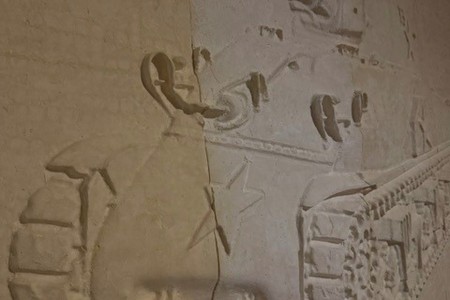
“During World War II, this installation proved that American manufacturing ingenuity could outproduce any adversary on the battlefield,” said John Cupp, Detroit Arsenal directorate of public works director, in a press release. “Today, we are bringing that same spirit of innovation to our infrastructure. By validating advanced additive manufacturing right here on our historic footprint, we are proving we can dramatically increase our energy resilience while maintaining continuous, uninterrupted operations.”
Concordia engineers develop technique for off-world 3D printing
One of the most frequently highlighted applications for 3D printing in construction seems to be building off-world habitats using lunar or Martian regolith. Should that be taken as an indicator of the technology’s immaturity? Perhaps, but it’s also because 3D printing offers a way to reduce the amount of construction materials transported to the Moon or Mars.
The latest attempt to tackle this challenge comes from a team of engineers at Concordia University in Montreal. They created a composite using simulated lunar regolith and recycled polyether ketone ketone (PEKK) and then used it to 3D print a wrench as well as sacrificial structures to test the material’s capacity for withstanding stress. According to the researchers, the added lunar regolith reduced shrinkage and warping during heat treatment. (So, if you’re experiencing those issues with your 3D printed PEKK parts, consider adding a little moon dust to your mix.)
What’s particularly notable here is the fact that the recycled PEKK came from previously used sacrificial structures, pointing toward the potential for closed-loop processing—a necessity for any space-based manufacturing. The one major downside is that the regolith-PEKK composite exhibited more internal porosity than unmixed PEKK, making it more brittle even though the recycled plastic itself was not degraded.
The research is published open-access in the journal Composites Part B: Engineering.
ICON raises $200M in Series D
If you’re still doubtful about the potential of additive construction, you probably haven’t heard about ICON’s latest funding round. The Austin-based start-up just announced $200M in Series D financing, co-led by Baillie Gifford and funds managed by BlackRock. The company says the financing will go toward manufacturing and deployment of its robotic construction systems, as well as a new R&D facility in Austin.
“When we started ICON, we believed intelligent machines could fundamentally change the way the world builds,” said Jason Ballard, co-founder and CEO of ICON, in a press release. “What the last decade taught us is that belief only matters if you can back it with real structures, real deployments, and real demand. We have all three.”
ICON claims that its multi-story robotic construction system known as Titan can reduce the construction time of an average home by six weeks at 40 percent lower cost than the national average, and its FormCrete—a proprietary building material for 3D printing—is engineered to make walls rated for 175+ mph winds and a 2+ hour fire rating. The company expects its revenue to quadruple in 2026, having built more than 270 homes and structures across five states and two countries.
ETH Zurich 3D printing for avalanches
This last item might be a bit of a stretch, since it doesn’t involve construction 3D printing directly, but it does involve a problem in infrastructure, a 3D printed scale model, and simulated rock avalanches. What more could you ask for?
Researchers in the department of civil, environmental, and geomatic engineering at ETH Zurich have been using 3D printed models to study rock avalanches in miniature, at a scale of 1:577 to be precise. “We want to use models like this to find out how mixtures of different materials move in the natural environment,” said Johan Gaume, professor of alpine mass movements at ETH Zurich, in a press release. The goal is to help those responsible for natural hazards determine whether particular pieces of infrastructure or even whole settlements are at risk.
Gaume and his colleagues used software to select a landform and break it down into small sections, then 3D printed the terrain segments piece by piece. They then assembled, coated, and painted the model, which Gaume characterized as “A vital step to achieve the desired roughness and optical properties” in the same release.
The researchers use multiple cameras, lasers, and sensors to depth of runoff, speed, runout distance, deposition, and impact dynamics of their artificial avalanche. They also precisely calculate the composition and the required proportions of the individual components, then blend the mixture in a bucket. The last step is to tip the mixture into a box at the top of their model before opening a hatch to trigger the event.
“This is a long-term investment in research, not a short-term experiment,” Gaume said. Numerous projects are set to be conducted here to investigate various effects, from erosion and impact against obstacles to the distance the masses travel up counter slopes. Gaume is currently focused on one process in particular: “At the moment, we’re especially interested in the influence of terrain curvature on flow dynamics.”
Missed the last additive construction update? Don’t worry: this is the first one!