Automotive expansions, new certifications, and a theory about the iPhone Duo’s 3D printed hinge cover.
With Formnext just over a month away, it’s been relatively quiet in the additive manufacturing (AM) industry as companies from across the globe prepare to descend on Frankfurt and announce their latest products and partnerships. Even so, there have been a few recent developments in the AM business world worth noting, particularly when it comes to automotive and consumer goods applications.
Hyundai 3D printing full-scale parts with ExOne
While I maintain that jigs, fixtures, and tooling are still the “killer app” for 3D printing in the auto industry, I have to admit that (partially) 3D printed cars may not be as improbable as I once thought. The latest evidence comes from the Hyundai Namyang R&D Center, where the South Korean automaker recently installed two ExOne VX1000 HSS polymer 3D printers. According to ExOne, Hyundai is investing in its sintering technology to produce large components, including complete door panels, for research and testing.
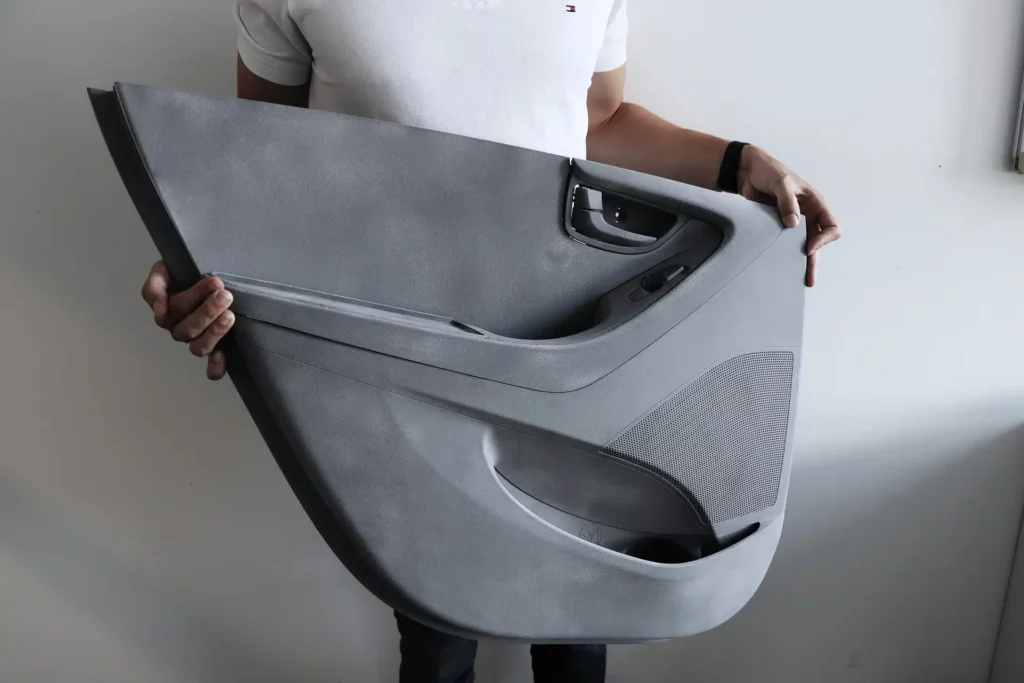
“Hyundai is using High Speed Sintering exactly as we designed it, for full-scale functional parts,” said Eric Bader, CEO of ExOne Global Holdings, in a press release. “Keeping large polymer parts accurate and repeatable, print after print, is one of the hardest challenges in polymer 3D printing. We solved it, and that turns additive manufacturing into a tool automotive teams can rely on for real development work.”
The two VX1000 HSS printers each have a print volume of 1,000 x 550 x190 mm (39.4 x 21.7 x 7.5 in) and process PA12 powder using a printhead with 8,000 nozzles selectively applying infrared-absorbing ink. Both are being run from a single unpacking station and a central powder supply.
MX3D achieves DNV AMC3 certification
Ensuring the quality and reliability of AM is crucial to the industry’s continued growth, and one way to do that is through independent assessments by risk management firms. One recent example comes from Amsterdam-based MX3D, which has achieved Additive Manufacturing Criticality 3 (AMC3) certification from DNV.
This makes it the first AMC3-certified wire arc additive manufacturing (WAAM) facility in the world, following a rigorous audit of the facility, software, and WAAM processes.
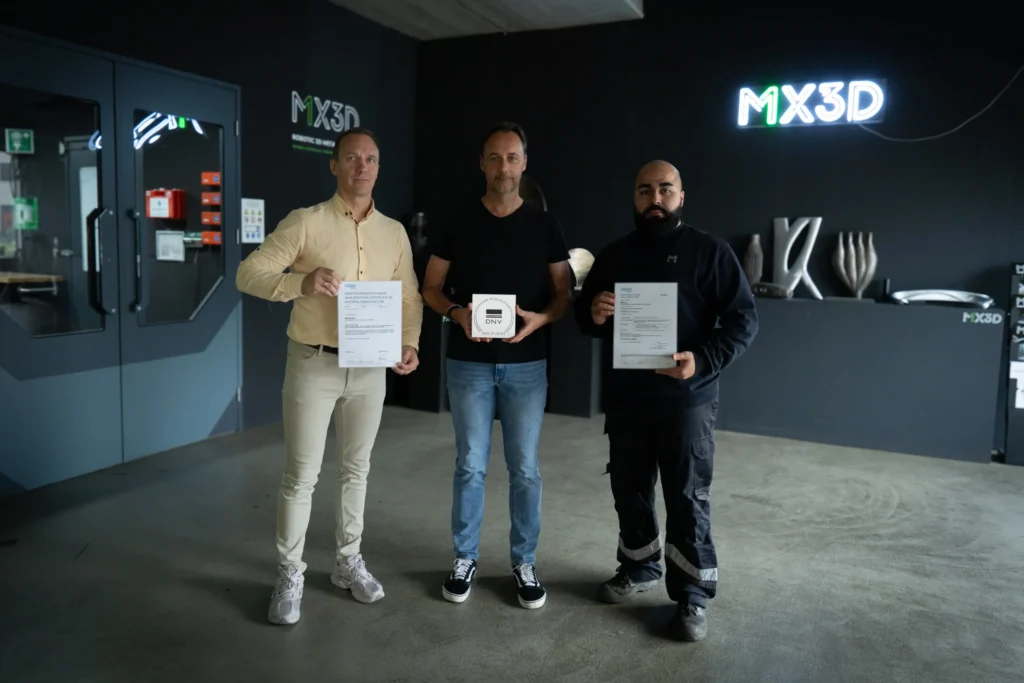
“Achieving the DNV AMC3 certification is a monumental milestone for MX3D and the entire WAAM industry,” said Gijs van der Velden, CEO of MX3D, in a press release. “This confirms that our technology and processes meet the most stringent quality and safety standards required for producing highly critical metal parts. We have proven that our robotic 3D metal printing technology is not only highly efficient and scalable, but fully ready to serve industries where reliability is non-negotiable.”
In this case, those industries include maritime, defense, and energy—all of which are highly promising markets for AM in general and WAAM in particular.
“On behalf of the DNV team, I congratulate MX3D on achieving a DNV Certificate of Qualification for its additive manufacturing facility in accordance with DNV-ST-B203,” said Sastry Kandukuri, global practice lead on additive manufacturing at DNV, in the same release. “As the first company globally to achieve DNV certification at AMC 3 level for DED-Arc/WAAM technology, MX3D has demonstrated a strong commitment to quality, qualification excellence, and the industrial adoption of additive manufacturing.”
Stratasys highlights GM adoption
Another item of note on the automotive front comes from Stratasys, which recently promoted the extent of its involvement with General Motors (GM), noting the presence of Stratasys AM solutions across more than 20 GM manufacturing facilities. According to Stratasys, GM is using fused deposition modeling (FDM) to produce tooling, jigs, fixtures, factory aids, and end-use parts.
In particular, Stratasys claims that its F900 FDM industrial production printers are lowering tooling costs, reducing lead times, and improving operational efficiency for the North American automaker.
“General Motors demonstrates what becomes possible when additive manufacturing is fully integrated into production operations,” said Yoav Zeif, CEO of Stratasys, in a press release. “Together, we’ve created an approach that turns factory-floor innovation into enterprise-wide business value, helping manufacturing teams improve performance, reduce costs and scale proven solutions across their operations.”
“Our greatest asset is our people,” said Doneen McDowell in the same release. “If we can give people the tools so they can own the outcome within their footprint, and then take those solutions and replicate them across our footprint where they apply, we’ll get the best outcome.” McDowell is manufacturing VP for GM North America full-size truck and large SUV assembly operations at General Motors.
Did BLT print the hinge cover for the iPhone Duo?
There’s been a lot of speculation about the technology behind the 3D printed hinge cover for Apple’s first foldable phone. I reached out to Emily Sousa, an AM engineer at Apple, last month in the hope of finding out more information, but—as is so often the case with engineers who work on cutting-edge projects—she wasn’t able to speak to the product beyond what’s been made publicly available.
Of course, there are only a handful of companies with the capability to produce 3D printed hinge covers from 100% recycled titanium in the quantities required for a highly popular consumer device like an iPhone, and one of those companies—Bright Laser Technologies (BLT)—just happened to release a video shortly after the Duo was announced. Filmed at this year’s RAPID+TCT, the video is about metal AM becoming a key driver of next-generation consumer electronics. Granted, its emphasis is on BLT’s collaboration with Oppo, but it’s not much of a leap to infer that Apple could be taking advantage of the same technology.
Missed the last Additive business update? Don’t worry: we’ve got you covered.