New reference platforms, datasets and runtimes support robot learning workflows from simulation and training through deployment.
NVIDIA announced an expansion of the NVIDIA Isaac open robotics development platform with a humanoid reference platform, new datasets, a runtime framework and updates to its robot learning tools. The additions support workflows that span data generation, simulation, training and deployment.
Agile ONE SN humanoid reference platform
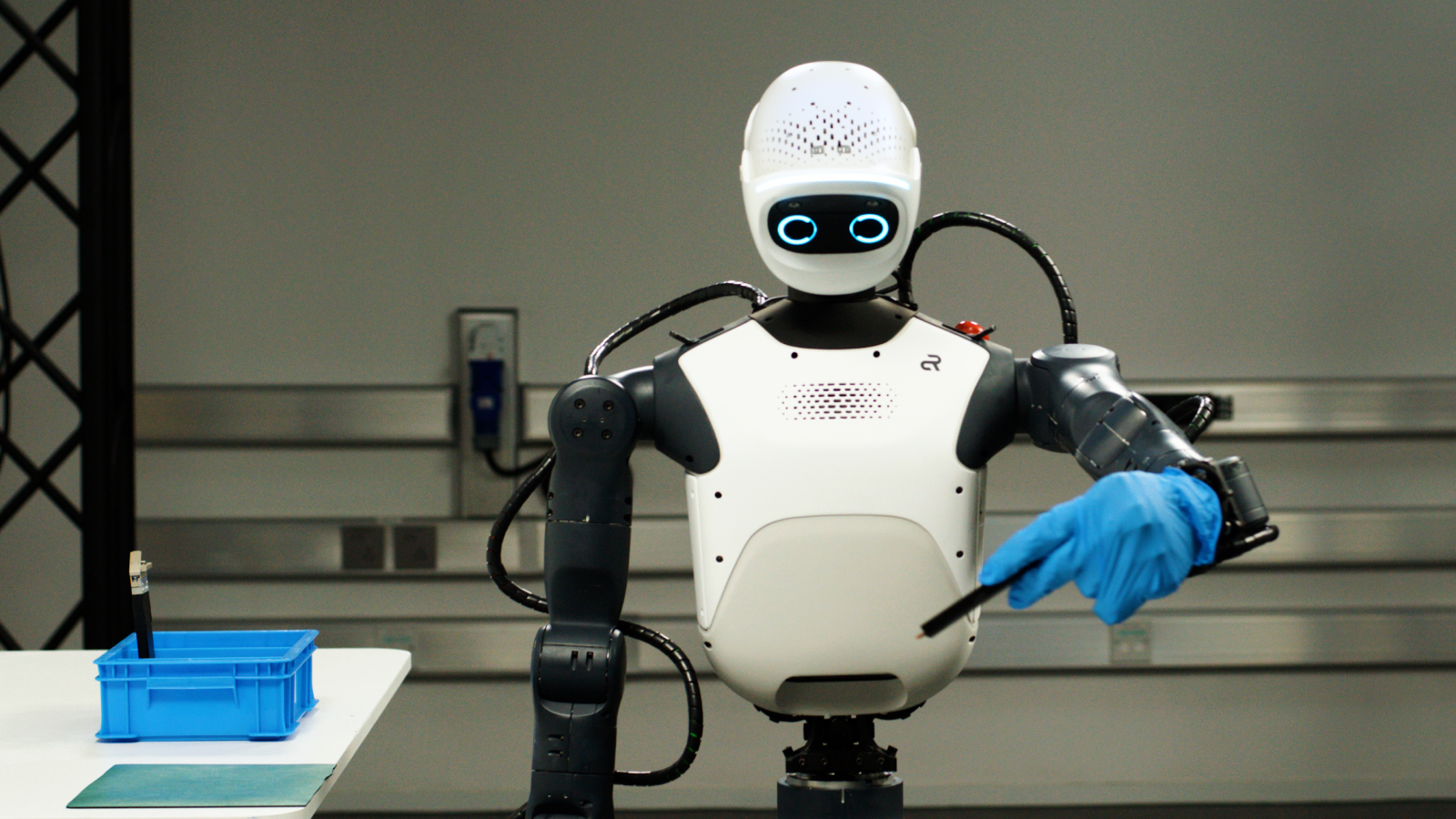
Agile Robots announced Agile ONE SN, a full-stack humanoid reference platform configured with NVIDIA Isaac GR00T and powered by the NVIDIA Jetson Thor edge AI platform.
Integrating simulation, training and deployment tools can require substantial engineering effort. Agile ONE SN combines these functions on one platform to support the development and testing of robot skills.
Agile ONE SN features:
- Agile ONE S humanoid body: Measures 1.40 meters (4.59 feet) tall, weighs 40 kilograms (88 pounds), provides 31 degrees of freedom and supports a 3-kilogram payload per arm.
- Dual WUJI Hand 2 hands: Each five-finger hand provides 20 degrees of freedom, 1 kHz force control and tactile sensing for manipulation tasks.
- NVIDIA Jetson Thor onboard computing: Provides 2,070 FP4 teraflops of compute and 128 GB of unified memory for onboard processing and real-time control.
- Multimodal sensing: Includes head and wrist cameras, lidar sensors and inertial measurement units for environmental perception and interaction.
- NVIDIA Isaac GR00T platform: Includes the GR00T foundation model, a workflow covering data capture through deployment and whole-body control for coordinated movement.
- Safety capabilities: Planned integration with NVIDIA Halos, a full-stack safety system for robotics.
Agile ONE SN is scheduled to be available in early 2027. The platform is intended for humanoid robotics research and development, with Stanford University and ETH Zurich among the institutions expressing interest.
NVIDIA technologies support robot learning workflows
NVIDIA introduced additional technologies for generating training data, scaling robot learning, creating simulation environments and deploying robot applications. These tools support development workflows from data preparation through deployment.
- SimReady Central Library: Provides more than 2,000 simulation-ready robotics and factory assets.
- Human 1M Dataset: Includes human activities, synchronized three-view video and 3D hand tracking. Both the SimReady Central Library and the Human 1M Dataset are available on Hugging Face. The complete Human 1M Dataset is available to Cosmos Coalition partners.
- NVIDIA Isaac Lab 3.0: Generally available as an open-source framework for training and refining robot policies from desktop systems to data centers. It supports multi-GPU workflows and physics engines including Newton and NVIDIA PhysX.
- NVIDIA Isaac OS: An open-source runtime framework built on NVIDIA Holoscan. It connects AI systems, sensors, controls and robot hardware for real-time operation across simulation and physical robots.
- DGX Station reference workflows: NVIDIA is releasing three open-source workflows for refining GR00T 1.7 models with reinforcement learning, training dexterous manipulation skills in NVIDIA Isaac Lab and post-training NVIDIA Cosmos world models for synthetic data generation using ChatGPT Astra.
- NVIDIA Halos: A safety platform built on NVIDIA IGX Thor to support the development and deployment of autonomous vehicles and robots.
The SimReady Central Library on Hugging Face includes simulation-ready assets from Comau, FANUC, ForgeCAD, Franka Robotics, LG Electronics, Palatial, Robotiq, Standard Bots, Universal Robots and Vertiv.
NVIDIA’s open-source robot learning reference workflows on DGX Station are supported by solutions from 1X, Agile Robots, Humanoid, Maven Robotics, Mentee, MicroAGI, Rhoda, Sereact and Skild AI.
Robotics companies integrating NVIDIA Halos into their safety architectures include Agile Robots, Agility, Dexory, FORT Robotics and KION. SICK is evaluating Halos for dynamic safety applications in industrial robots that must respond to changing conditions outside fixed safety zones.
Advantech and NexCOBOT are developing industrial computing platforms based on NVIDIA IGX. Reynolds & Moore, Accenture and TÜV SÜD are working on processes for certifying industrial physical AI systems.
European robotics companies use NVIDIA technologies
ABB Robotics is integrating NVIDIA Omniverse libraries with RobotStudio HyperReality to simulate and virtually commission robotic systems before installation. KUKA Group is using Omniverse libraries in Visual Components FactoryLens to add real-time rendering to factory simulation workflows. Sereact is using Isaac GR00T with Cosmos Transfer to train and post-train its Cortex platform for goods-handling applications on Universal Robots industrial robot arms.
Humanoid is using Jetson Thor, Holoscan Sensor Bridge, Halos and NVIDIA Isaac OS to develop and validate robot behaviors before industrial pilot projects. Hexagon Robotics is using these technologies to develop AEON perception capabilities including teleoperation video, localization, mapping and object pose detection. Bear Robotics is using them to support KR1 perception and model execution and to post-train Isaac GR00T through Kino-2 for warehouse, returns and industrial applications.
Toyota Material Handling Europe and SoftServe are using Omniverse and NVIDIA Isaac Sim to develop autonomous material-handling systems. The companies report that the approach can reduce deployment time by up to 50%. Idealworks is using NVIDIA open models and Jetson to develop memory capabilities for autonomous mobile robots in factories. Analog Devices Inc. is using NVIDIA Jetson AGX Orin and the cuVSLAM library to develop autonomous mobile robots.
Hugging Face and Pollen Robotics are using NVIDIA Isaac Lab, Isaac Sim and Newton to develop Microduck, an open-source robot for training, modifying and sharing physical behaviors. Franka Robotics is using NVIDIA NIM microservices and Isaac Sim to convert natural-language requests into actions on its Franka FR3 Duo robot system.
Bellboy is using Jetson and GR00T for Billie, a robot developed on the company’s physical AI infrastructure. According to Bellboy, Billie has been deployed at hotels operated by Marriott, Hilton, IHG and OYO.
Flexion is using Isaac Lab and Newton to develop Reflect, a robot intelligence model that combines reasoning with whole-body movement for manipulation tasks across different robot platforms. Schaeffler is contributing actuator technology to Newton as a foundational component for humanoid robot development with NVIDIA Isaac Lab and Isaac Sim.
NEURA Robotics is using Isaac Sim and Isaac Lab to generate synthetic training data and train robot skills in simulation for Neuron AI, its multimodal foundation model.
For more information, visit nvidia.com.