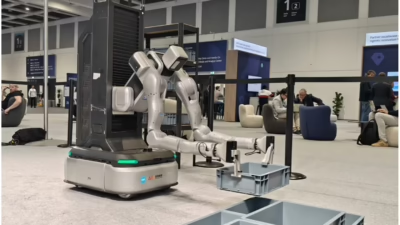
Demonstrated at the Japan International Machine Tool Fair in Tokyo, the system combines AI, a CNC machine equipped with physical AI and a general-purpose humanoid robot.
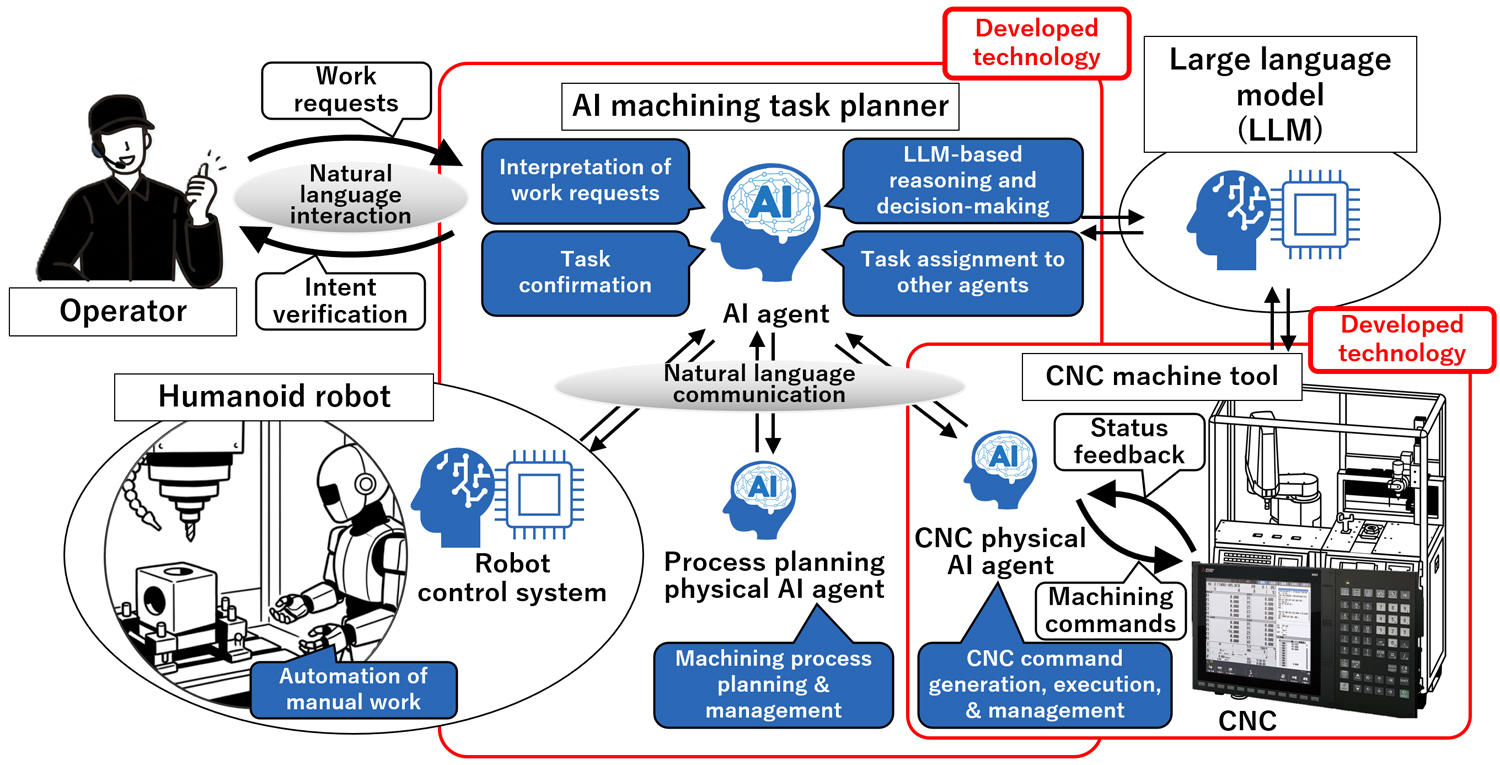
Mitsubishi Electric Corp. is developing a machining system that uses AI to coordinate work between CNC machine tools and humanoid robots, giving machine tools an active role in coordinating manufacturing operations.
Demonstrated at the Japan International Machine Tool Fair (JIMTOF) 2026 in Tokyo, the system combines an AI-based machining task planner, a CNC machine equipped with physical AI and a general-purpose humanoid robot from Galaxea Dynamics.
In the demonstration, an operator used voice input to specify text to be machined onto a tag. The AI generated the machining program, after which the robot and CNC machine carried out the remaining tasks autonomously.
“We used a custom-built machine tool equipped with our CNC system, as well as a humanoid robot from Galaxea Dynamics,” said Shun Otsubo, VLA Foundation Model Technology Group, Mitsubishi Electric. “First, we used voice input to specify the text to be machined onto a tag. Then, AI generated the machining program. Based on that program, the entire process was carried out autonomously. The robot set up the workpiece, the CNC machine performed the machining, and the robot removed the finished workpiece.”
The system’s central component is an AI machining task planner that interprets operator instructions, generates machining tasks and coordinates their execution by the CNC machine and humanoid robot. The AI and CNC communicate through the Model Context Protocol (MCP), which allows the planner to control the machine directly. Communication between the AI and robot uses the Robot Operating System (ROS). The systems connect through either Wi-Fi or a wired LAN.
The CNC machine’s physical AI capability allows it to respond to instructions from the task planner, change machining modes and load machining programs. It can also provide operational information in response to the planner’s queries, including information from machine manuals and alarm data.
Both the AI task planner and the physical AI integrated into the CNC machine use Mitsubishi Electric’s proprietary Maisart technology. The company’s process-planning AI generates task plans through an interactive process, with a separate AI reviewing the generated plans for internal validation.
The system also uses a pre-registered task library containing the motions and tasks the robot can perform, along with information about the connected CNC machine’s capabilities and the types of workpieces it can handle. Changes to the robot’s physical parameters, machine capabilities or workpieces require corresponding updates to the library.
“The AI machining task planner must be configured with the required robot motions for production, such as grasping and placing parts in fixtures. If non-standard machining procedures are used, the operator must also instruct the AI task planner using natural language,” said Tomoya Fujita, NC System Group, Mitsubishi Electric.
The cameras and sensors verify task completion before the system proceeds to the next task. The system can repeat a grasping task if the robot fails to pick up a workpiece. However, if a workpiece is incorrectly positioned and cannot be placed inside the machine tool, the current system sounds an alarm. Automatic recovery from that situation is still in development.
Human approval is required before the AI performs actions affecting the physical world. Mitsubishi Electric identifies starting a machining operation, changing parameters and changing CNC machine settings as examples of actions requiring approval.
Fujita identifies several potential applications, including existing production lines designed around tasks performed by human workers, factories with multiple CNC machines requiring frequent workpiece loading and setup changes, and operations machining relatively small parts. Humanoid robots may be less suitable for handling heavier workpieces.
Mitsubishi Electric plans to enable operation on its current mainstream CNC series through software installation. Supporting older-generation CNC machines through an industrial PC running the software is also under consideration, although the company describes this as a concept rather than a commitment to product specifications.
For now, the CNC machine and robot operate under the direction of the AI machining task planner, with operators providing production instructions. Integration with higher-level production systems, including manufacturing execution systems and production scheduling, remains a subject for future research.
“We are currently conducting validation research and hope to begin trials at our production sites and elsewhere in the future. When the technology becomes practical around 2030, we plan to start by automating routine tasks performed by workers around machine tools, then gradually expanding its capabilities to handle non-routine tasks. Commercialization plans have not yet been determined,” said Fujita.