The scanner offers four capture methods, Wi-Fi 7 connectivity and up to 0.02 mm accuracy for field-based workflows.
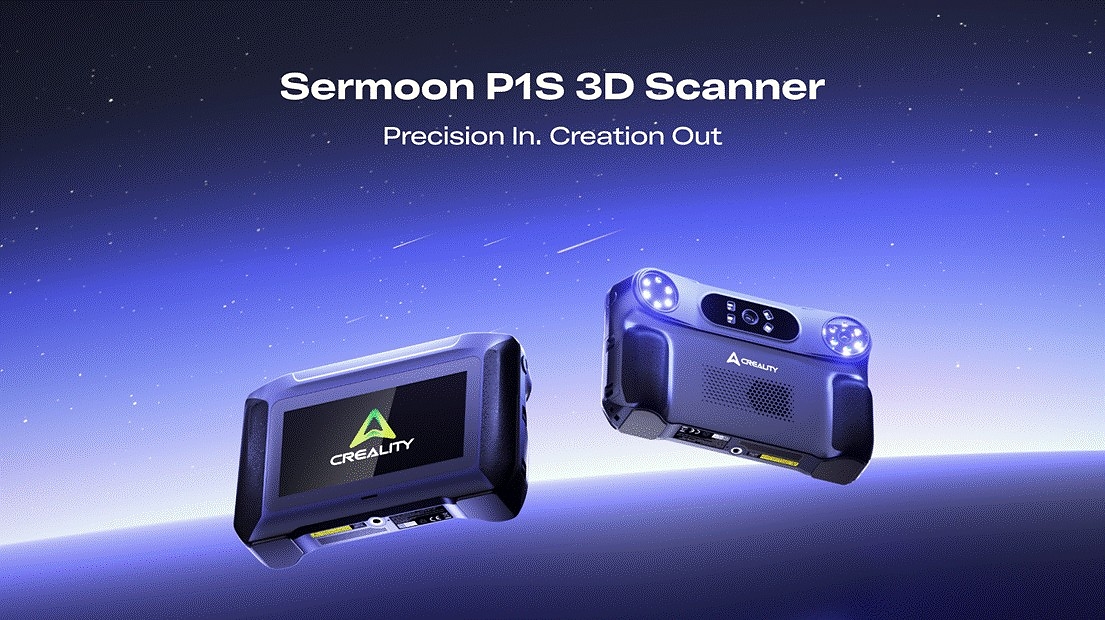
Creality announced the worldwide availability of the Sermoon P1S, an all-in-one blue-laser 3D scanner for reverse engineering, automotive applications, field digitization and scan-to-model workflows.
The Sermoon P1S includes onboard computing, local storage and a 6-inch touchscreen, allowing users to capture objects, review scan coverage and perform common processing tasks without connecting to a separate computer. This standalone workflow is intended for scanning vehicles, machinery, large parts and other objects that are difficult to move to a fixed scanning station.
Four scanning methods for different geometries
The Sermoon P1S combines 34 cross laser lines, seven parallel laser lines, one blue laser line and near-infrared (NIR) structured light. Users can select a scanning method based on the object’s geometry and the required level of detail.
The 34 cross laser lines support coverage of larger surfaces. The seven parallel laser lines are intended for surface features and smaller geometric details. The single blue laser line supports scanning of recessed areas such as narrow grooves and deep holes.
NIR structured light provides another option for small- and medium-sized objects. Creality’s MASK technology is designed to capture surface contours and fine details.
The four scanning methods allow the P1S to handle detailed components, recessed features, larger workpieces and marker-free scanning in one device.
Capture specifications for reverse engineering
In blue-laser mode, the Sermoon P1S provides accuracy of up to 0.02 mm and volumetric accuracy of 0.02 mm + 0.08 mm/m. These specifications support reverse-engineering tasks such as CAD reconstruction, fit checks, part replication and design iteration.
The scanner includes a glass calibration board for establishing a dimensional reference.
Blue-laser scanning operates at up to 60 frames per second (FPS) in standalone mode and up to 100 FPS when connected to a PC. NIR scanning operates at up to 20 FPS in standalone mode and up to 30 FPS with a PC connection.
The scanning speed and projection options are intended to support continuous handheld movement and reduce the time required to capture surface coverage.
Accuracy figures are based on laboratory testing. Results may vary depending on vibration, temperature, operating conditions and other environmental factors.
Standalone operation and PC connectivity
The Sermoon P1S weighs 807 g including the battery. It includes an eight-core Qualcomm CPU operating at up to 3.36 GHz, an Adreno 740 GPU, an FPGA, 16 GB of LPDDR5X memory and 256 GB of UFS 4.0 storage.
The 6-inch touchscreen provides access to device controls and live scan review. Users can check scan coverage while working near the object.
The scanner supports standalone operation, wireless PC connection and wired PC connection. Wi-Fi 7 supports wireless communication with a PC when additional desktop processing is required, while USB 3.0 supports wired operation.
Two replaceable 3,300 mAh batteries and PD 3.0 fast charging support longer scanning sessions.
Scanning in outdoor and difficult lighting conditions
The Sermoon P1S supports blue-laser scanning in outdoor lighting conditions up to 110,000 lux. NIR structured-light scanning supports up to 80,000 lux when used with the included NIR filter.
The filter is designed to reduce interference from ambient light during outdoor scanning.
Dark surfaces can absorb projected light while reflective metals can produce inconsistent returns. On suitable dark and metallic surfaces, the P1S is designed to reduce the need for scanning spray. This can reduce preparation and cleanup for automotive parts, finished components and other objects where applying spray is impractical.
From scan capture to digital model
CrealityScan combines scanning, optimization and basic model processing in one software environment. The software supports STL, OBJ and PLY file formats.
It also includes AI-assisted hole filling to repair missing surfaces and reduce manual cleanup after scanning. This function processes captured data and does not change the scanner’s physical capture capabilities.
On-device processing allows common scan and model operations to be completed near the point of capture. Users can also transfer data to CAD, modeling and fabrication software for additional processing.
Creality supports the platform with over-the-air (OTA) updates for software features, workflows and scanning algorithms. The P1S is part of Creality’s scan-to-model-to-print workflow, connecting 3D capture with digital editing and fabrication.
Applications in professional and educational workflows
For reverse engineering, the P1S can capture existing components as references for CAD reconstruction. The single blue laser line supports recessed geometry while the seven parallel laser lines are intended for smaller surface features.
For automotive applications, the 34 cross laser lines support larger areas such as body panels and vehicle components. Standalone operation can also reduce the equipment required when scanning around a vehicle.
For 3D printing users and makers, the scanner can capture existing objects for modification, reproduction, mating-part development or new designs before modeling and fabrication.
Its portability also supports research, education and digital preservation applications in which objects need to be scanned at their existing location. Creality identifies reverse engineering and automotive inspection as primary professional applications, with 3D printing and maker workflows as additional uses.
For more information, visit creality.com.