The connectors support centered PCB mounting, four- and five-pin interfaces and operating temperatures from -40°C to +85°C.
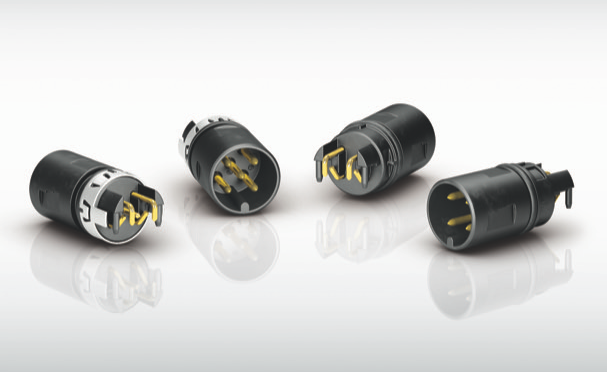
binder is expanding its M12 product range with angled panel-mount connectors for centered PCB mounting. The connectors receive the circuit board at its edge and align with the board rather than sitting on top of it. This configuration avoids adding the connector and PCB heights together which can be useful when electronics must fit inside a slim cylindrical housing. The THR version is suitable for reflow soldering on a standard SMT line.
PCB on the center axis
With conventional PCB mounting, the connector sits on top of the board. The overall height of the assembly is the combined height of the connector and the board which can affect the diameter of a round housing.
The angled M12-A panel-mount connector uses a different mounting arrangement. It receives the PCB at its front edge while the contacts extend through the board from above and below. The connector axis is positioned in the plane of the board and can align with the axis of a cylindrical housing. The mounting design accommodates PCB thicknesses from 1 to 2 mm.
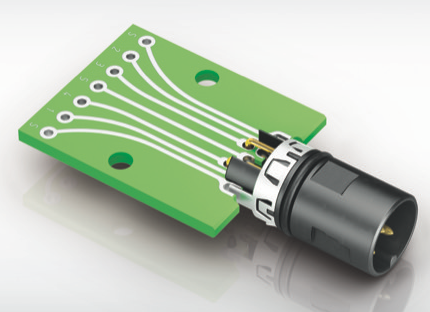
Application: sensors in tubular housings
The design is intended for sensors installed in tubular housings. In these applications, the housing diameter may be limited by the installation space and the electronics must fit on a narrow circuit board. The populated PCB can be inserted into the tube with the connector positioned at the front which places the electrical interface at the center of the housing face.
Because the connector does not sit on top of the PCB, the available cross-section for the electronics is maintained. This can also allow the use of a smaller housing. In some sensor-tube designs, panel-mount connectors with straight contacts are connected to the PCB using wires and a manual soldering process. The angled connector can eliminate this wiring and soldering step.
Other potential applications include systems that require a standardized M12 interface within limited installation space:
- Level, distance and pressure sensors
- Light barriers and position switches
- Measuring transducers in cylindrical housings
- Fieldbus and peripheral devices with limited installation space
Processing on a standard manufacturing line
THR technology allows the connector to be soldered during the standard reflow process which eliminates a separate soldering operation. An integrated pickup surface allows a pick-and-place machine to handle the component and place it with the other components on the assembly line.
This process can reduce manual work and the number of manufacturing steps while supporting consistent solder-joint quality.
Technical features
- Design: Angled front-mounted centered PCB mounting (midmount)
- Interface: M12 A-coded according to DIN EN 61076-2-101 available in four- and five-pin versions
- Variants: Shielded or unshielded with or without an O-ring
- Termination: THR reflow-solderable with an integrated pickup surface
- PCB thickness: 1 to 2 mm
- Protection rating: IP68 when mated and locked
- Electrical ratings: 60 V rated voltage and 1,500 V rated impulse withstand voltage
- Operating environment: -40°C to +85°C and more than 100 mating cycles
- Materials: Gold-plated contacts and an LCP contact body rated UL 94 V-0
The angled M12-A panel-mount connectors provide centered PCB mounting and THR termination for devices with limited internal space and standardized M12 interfaces. The connectors are compatible with existing solutions on the market and provide an additional sourcing option for this type of interface.
For more information, visit binder-usa.com.